
Cobb Released Mugshot Records
A mugshot, more formally a booking photograph, is made during arrest or jail intake. Release does not erase the underlying agency record. Cobb Sheriff’s Records & Identification operation maintains photographs along with incarceration records, fingerprints, and court documents. That does not mean every photo is placed on a public website. The official Cobb inmate-search description confirms an in-custody search for charges and bond amounts, but the Sheriff sources reviewed do not confirm a public gallery of photos for released people.
Custody status and photo access are separate questions. A person may drop from the live jail search after bond, sentence completion, or transfer while the booking image remains in the Sheriff’s record system. Conversely, a photo found elsewhere does not prove current custody, release date, or case result. Use the booking and release record for those facts.
Where Cobb Released Mugshots Appear
Start with the agency connected to the custody event. A Cobb-only jail stay belongs with the Sheriff. A state-prison sentence belongs with GDC. A registry applies only when the law requires registration. News and commercial pages are not substitutes for the official booking, release, or court record.
| Channel | Photo status | How to access |
|---|---|---|
| Cobb Sheriff live search | Not confirmed by official text for released people | Use the official in-custody search, then ask Records & Identification about the maintained photo. |
| Cobb Sheriff mobile app | No photo module verified | Use for agency alerts and updates, not as a promised mugshot gallery. |
| Open-records request | Maintained photo may be requestable, subject to law | Send a purpose-neutral request and any compliance statement required by O.C.G.A. 35-1-19. |
| GDC offender search | Displays a photo if available | Use only for a person in the GDC system, not a local-only Cobb jail stay. |
| Cobb and GBI registries | May show a registry image | Use only for a person required to register; it is not a general release list. |
| News coverage | May reproduce an image in a newsworthy report | Read it as dated reporting and confirm facts with the originating agency. |
| Commercial pages | May be stale, incomplete, or misidentified | No commercial mugshot source is linked or endorsed. |
The Cobb County release-record path is the better source for the date and reason the person left custody.
Cobb Sheriff App Photo Limits
Cobb County has an official Sheriff’s Office app for Apple and Android devices. The published store descriptions emphasize public safety news, emergency alerts, tips, feedback, and interactive features. They do not verify a recent-release list or booking-photo module. The app is therefore an official communication source, but it should not be presented as a way to browse released inmate mugshots.
The Cobb Sheriff app listing for Apple and the official Android listing describe the available agency features. App screens and features can change, so a person seeking a photo should still use Records & Identification or the proper state source.
That limit also applies to Cobb’s web search. The public Sheriff wording supports in-custody charges and bond amounts, not a retained released-person photo archive. Disappearance from the roster is not evidence that a photo was deleted. It only means the live custody view is no longer a dependable place to verify release or image availability.
Note: The official app can carry Cobb Sheriff alerts without offering a released-inmate photo search.
Request Cobb County Booking Photos
Records & Identification is the direct Cobb source because the Sheriff says that unit maintains detainee photographs. Georgia’s Open Records Act treats photographs and computer data as records, but booking photos have an added disclosure rule. A request should identify the exact booking and avoid asking for broad publication rights that the agency cannot grant.
- Identify the person by full legal name and, if known, SOID, booking number, booking date, or court case number. This helps separate people with similar names.
- Contact Cobb Sheriff Open Record Requests at (770) 499-4728 or Records & Identification at (770) 499-4231 and ask for the official submission method.
- Describe the requested booking photograph and its related booking in narrow, purpose-neutral terms. Request the release record separately if the date or release reason is also needed.
- Provide the compliance statement required by Georgia booking-photo law if the custodian asks for it. Do not claim a purpose or right that does not apply.
- Review the agency response. Under O.C.G.A. 50-18-71, available records generally must be produced within three business days or the agency must describe them and give a production timeline.
- Compare the image with booking identifiers and the court record. A photo alone does not show disposition or whether charges led to conviction.
The Georgia Open Records Act permits copy charges of no more than ten cents per letter- or legal-size page and does not charge for the first quarter hour of search, retrieval, or redaction. Other lawful costs may depend on the record and production method. Ask for an estimate rather than assuming a flat photo fee.
Georgia Booking Photo Restrictions
O.C.G.A. 35-1-19 makes Cobb County mugshot access more limited than in states with sheriff-run booking galleries. The statute generally prevents an arresting law enforcement agency from posting booking photographs on a website, subject to listed exceptions. It also restricts providing a booking photo when the image may be placed in a publication or website that charges for removal. A requester may have to give the agency a statement that the request complies with the law.
The official statute page illustrates the restriction that governs Georgia booking-photo publication.
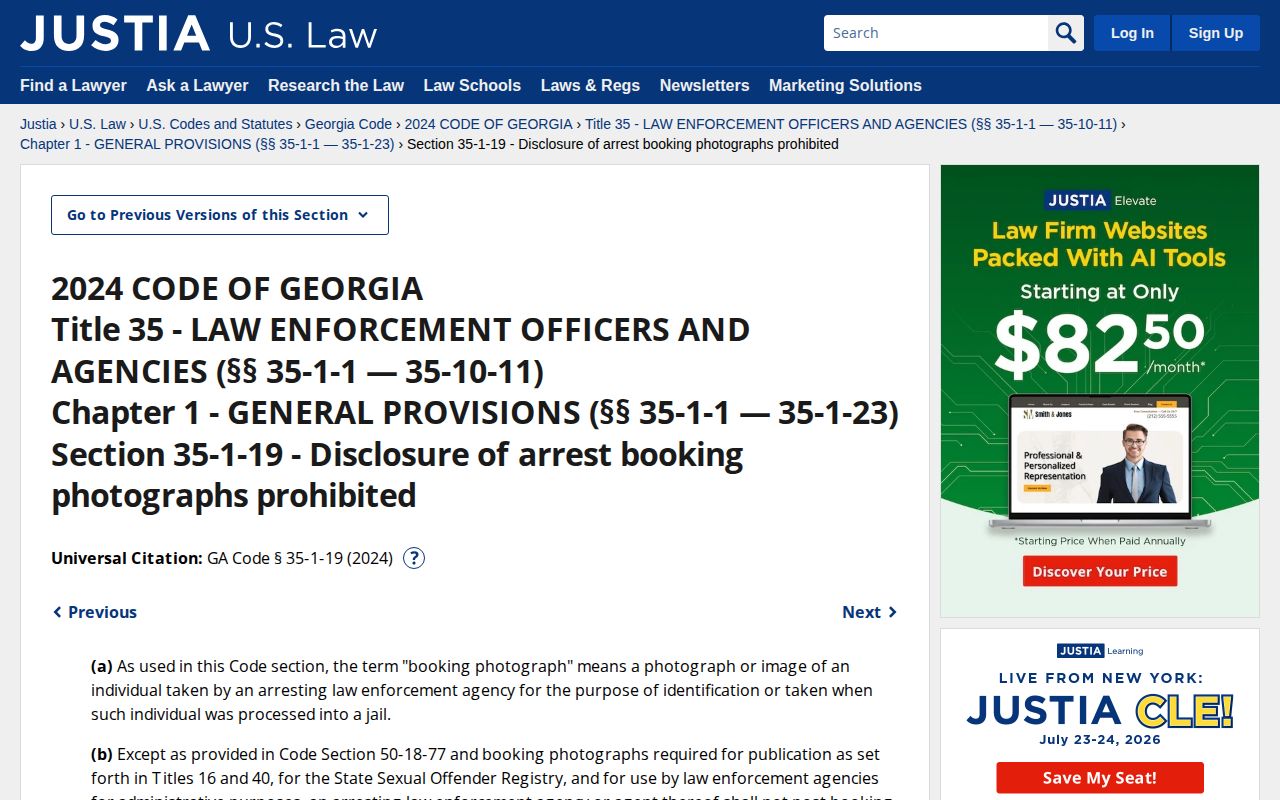
The law explains why the absence of a Cobb Sheriff mugshot gallery is not a missing search feature and why an individual request may still require review.
The restrictions do not convert a mugshot into proof of guilt. A booking photo records an arrest-stage event. Dismissal, acquittal, record restriction, or another disposition must be checked through the court and prosecutor records.
GDC Photos After Cobb Release
GDC’s offender search is a photo channel only when the person entered Georgia state custody. GDC warns that photographs are displayed automatically if available. A person who spent time only at the Cobb Adult Detention Center may have no GDC record at all. If a Cobb jail release was actually a transfer to state prison, the GDC record becomes the next relevant source.
Search the Georgia offender database by name, ID, case number, age, or identifying details. Match the GDC ID, physical details, offense, and status before relying on the image. GDC directs users to verify information in writing with Inmate Records and Information, PO Box 1529, Forsyth, GA 31029. Its warning matters because photos and status fields can be incomplete.
- Booking photograph
- An image created during arrest or jail intake.
- Offender photograph
- An image displayed in a corrections record when available.
- Record restriction
- A Georgia process that limits access to qualifying criminal-history information after approval.
- Disposition
- The court outcome, which a photograph does not show.
Cobb Registry Photos Are Limited
Cobb Sheriff maintains a sex offender registry for people who live, work, or attend school in Cobb County, and it sends the information to GBI for online county viewing. That registry can be relevant after release only when the person has a legal duty to register. It is not a general list of released inmates, and a registry record does not establish the release date from the Cobb jail.
The Cobb Sheriff registry page explains the local registry’s limited scope.
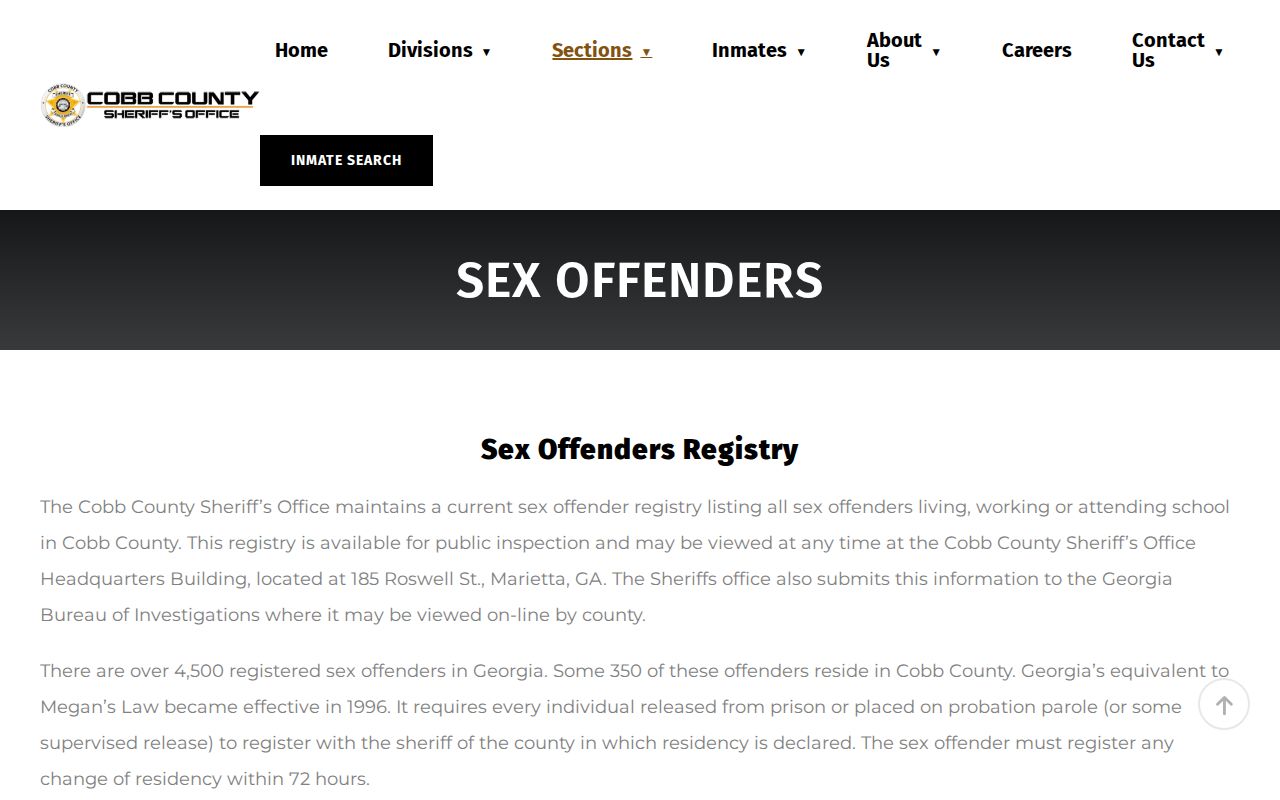
This official Cobb view helps separate a status registry from a broad mugshot or recent-release search.
The GBI sex offender registry is the state channel. Check the jail, GDC, and court records for everyone outside the registry’s narrow legal coverage.
Cobb Mugshots Beyond Official Sources
Commercial mugshot pages and broad data collections may retain old images, omit later case results, or attach a photo to the wrong person. They are described only as a category because readers may encounter them. No commercial mugshot publisher, data broker, or paid removal vendor is linked or endorsed. The official agency and court records are the sources to use for a correction or verified outcome.
A copied image may also lose the booking number, arrest date, and agency label that made the original record understandable. Without those fields, even an authentic photo can be tied to the wrong release event. Preserve the source context when comparing a Cobb image with a court disposition.
Legitimate news outlets may publish booking images in news and commentary. Such coverage is event based, not a full Cobb County release index. Publication date matters. A report written at arrest may remain online long after release or dismissal and may not have a later update.
Note: An image found through news coverage should be checked against the Cobb booking record and the court’s final disposition.
Cobb Mugshot Removal and Restriction
The Georgia Attorney General’s mugshot guidance explains O.C.G.A. 10-1-393.5. A commercial mugshot website must remove a qualifying image without charge within thirty days after a written request. Qualifying outcomes include certain restricted charges, non-prosecution, dismissal, no bill, acquittal, and specified drug dispositions. The rule does not promise that every arrest photo vanishes from every lawful source.
The state consumer guidance is shown in the official Georgia mugshot-removal resource.
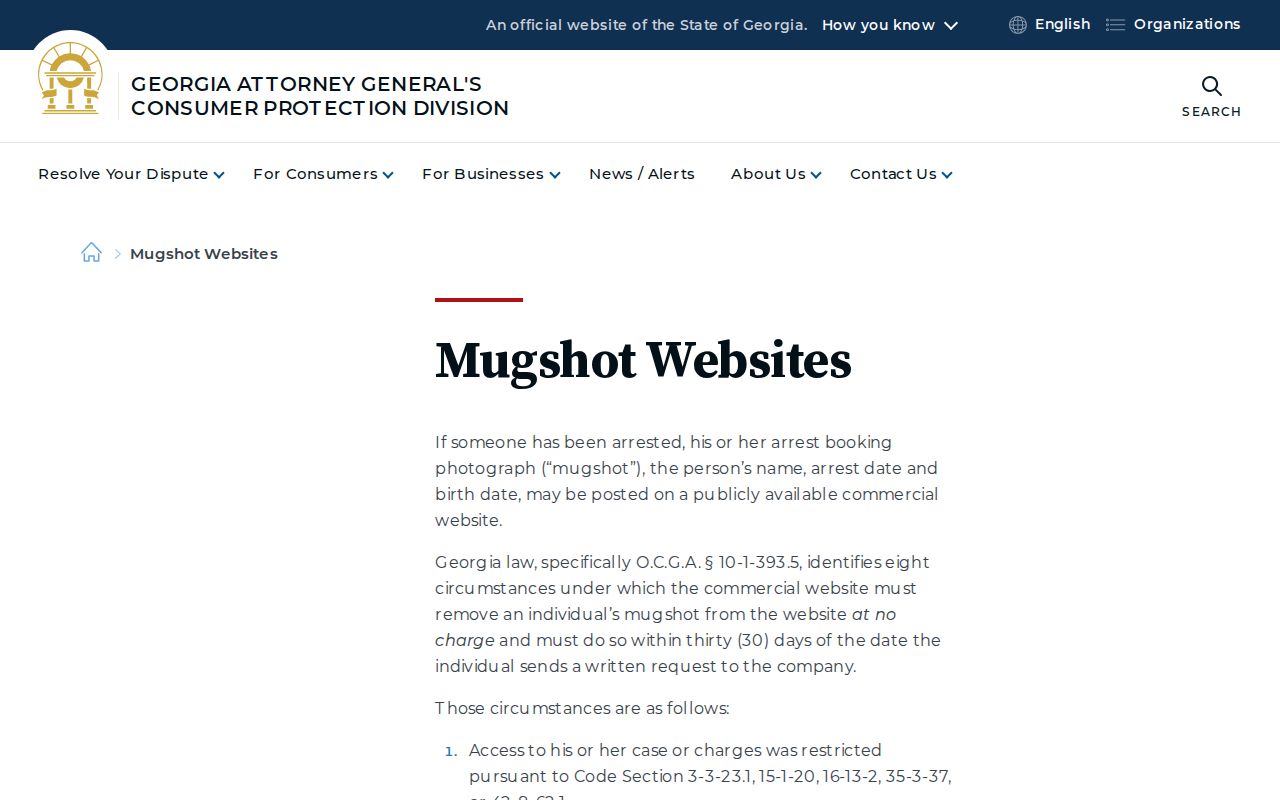
The page’s remedy is aimed at qualifying commercial publication, while official record access follows separate law.
Georgia criminal-history record restriction is another process. Under O.C.G.A. 35-3-37, arrests after July 1, 2013 generally require contact with the prosecutor; older arrests use the arresting agency application path. Restriction can affect ordinary public visibility, but it should not be described as automatic deletion of every photo. A party seeking restriction should use the prosecutor, arresting agency, GBI, and court procedures that match the arrest date.