
Cobb State Court Record Timing
Cobb State Court’s online search covers traffic and misdemeanor cases filed from April 26, 1999 through the current year. That makes it a useful starting point for locating the case tied to an SEU sentence. The court states that its online information is a courtesy, may not contain the most current or complete record, and does not replace the official file maintained by the Clerk.
Timing matters just after release. State Court says today’s case-management updates are available on the next day. That statement concerns court data only. It does not establish when the Sheriff updates the jail roster, when VINE sends a custody notice, or when SEU records an in-person report. Compare dates rather than forcing all systems into one update schedule.
When an online entry conflicts with release papers or the sentencing order, request the official record from the State Court Clerk. Case assistance and the Criminal Division can route court-record questions, while SEU intake handles the post-release reporting process. The Sheriff remains the custodian for the Cobb jail release record.
Cobb Misdemeanor Release Trail
A release to misdemeanor probation can involve several dated records. The Sheriff’s booking record identifies local custody. A bond or sentence entry explains the court action. The jail release record provides the time and reason custody ended. The sentencing order states the probation term and reporting direction. SEU then documents the local supervision process.
Those records may update on different schedules. Cobb State Court says current-day case-management changes become available online on the next day, while no official jail roster cadence is published. A person may leave custody before the latest court entry is visible online. Phone confirmation and formal records are stronger than guessing from an empty roster result.
The case type controls the route. State Court covers misdemeanor and traffic matters in its stated scope. Magistrate Court handles early proceedings and warrants, while Superior Court is the key source for felony sentencing. If a case moved beyond State Court scope, SEU should not be asked to explain another court’s order.
A later violation, revocation, or warrant can create a new custody event. The original release date, start of probation, alleged violation, court decision, and later booking are separate facts. Match each one to its date and agency so a current jail record is not mistaken for the whole probation history.
Cobb SEU Post-Release Role
The Cobb State Court Sentence Enforcement Unit handles misdemeanor cases sentenced in Cobb State Court. Its official explanation defines a probated sentence as a sentence to confinement that may be served outside confinement while the person complies with court conditions. That makes the SEU a post-release supervision unit, not a detention facility.
The unit’s scope is narrow and important. A misdemeanor defendant may leave the Cobb Adult Detention Center and report to SEU. A felony probationer or parolee generally belongs with the Georgia Department of Community Supervision instead. A person transferred from Cobb jail to GDC remains in state custody and has not entered SEU supervision merely because the local jail booking ended.
Report After Cobb Release
Cobb provides a specific instruction for people sentenced to misdemeanor probation in State Court: report in person to the SEU Intake Office within three business days after release, unless the sentencing order states another time. The order controls when its language differs from the general page.
- Keep the release paperwork and sentencing order available when leaving custody.
- Confirm that the sentence is a Cobb State Court misdemeanor matter assigned to SEU.
- Read the reporting deadline and location written in the order.
- If the general rule applies, report in person to intake within three business days of release.
- Call the intake number when process or location details need clarification, without assuming phone contact replaces an in-person direction.
- Retain proof of reporting and follow the instructions issued by the unit.
A “business day” is used by the official instruction, so the release date and the actual order should be checked rather than guessed. The research does not supply a holiday-counting formula. Prompt contact is the safer response when a deadline is uncertain.
Note: The sentencing order may set a different reporting time, and its case-specific language takes priority over the general three-business-day statement.
Cobb SEU Intake Contacts
Intake and general SEU questions have separate published numbers. The official source places intake in the Cobb County State Court Building.
Cobb State Court Sentence Enforcement Unit Intake
12 East Park Square, 3rd floor
Marietta, GA 30090
Intake: (770) 427-2952
General SEU: (770) 528-1795
State Court case assistance: (770) 528-2660
Criminal Division: (770) 528-1246
Intake is the relevant contact for the immediate reporting process. General case records remain with the State Court Clerk, and custody release records remain with the Sheriff. Keeping those record custodians separate avoids asking the probation unit to certify a jail release or asking the jail to interpret probation conditions.
The manifest capture shows the official Cobb misdemeanor probation source.
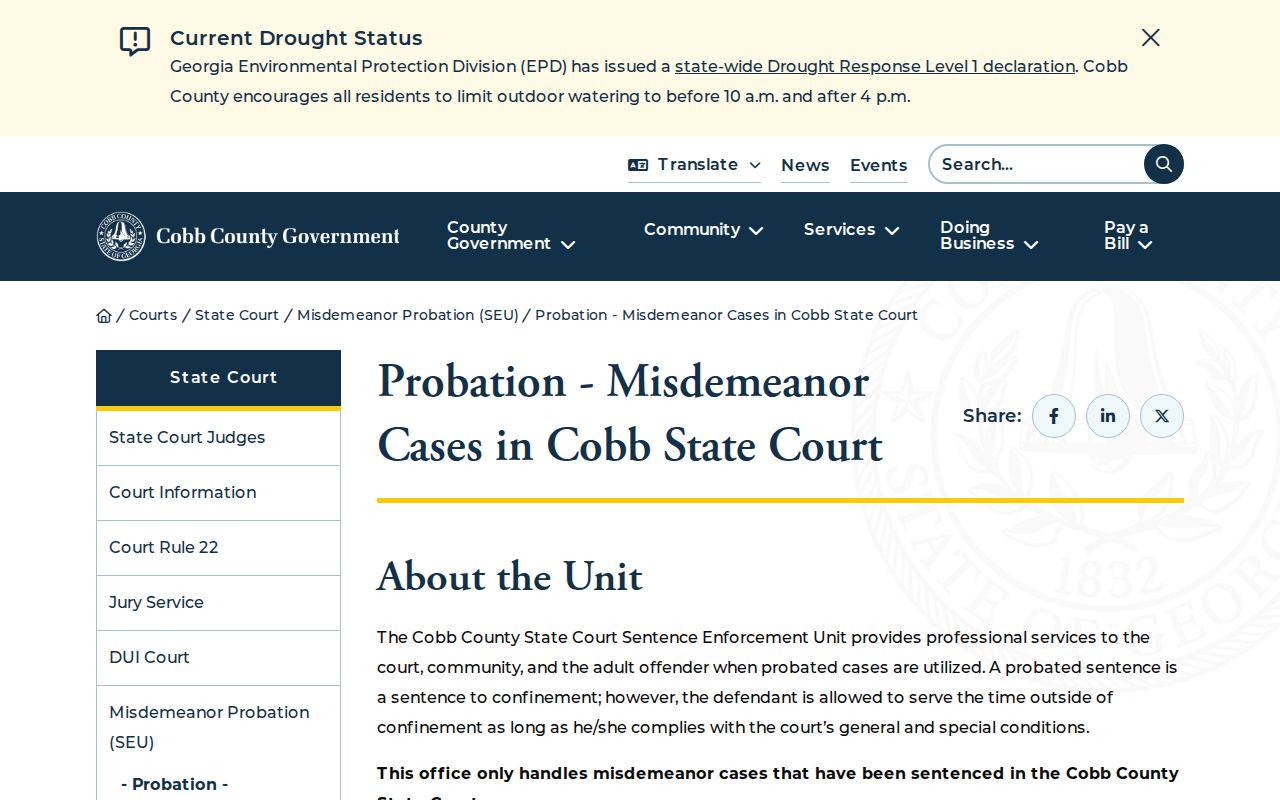
The page supports the unit’s misdemeanor scope, intake address, and three-business-day reporting direction.
Confirm Cobb SEU Supervision
The sentencing order is the strongest public starting point because it states the punishment and conditions imposed by the court. Cobb State Court’s online record search covers traffic and misdemeanor cases filed from April 26, 1999 through the current year. The court warns that the online display is a courtesy and that its official record takes precedence.
| Question | Correct source | Limit |
|---|---|---|
| Was misdemeanor probation imposed? | State Court sentencing order | Online summary may omit terms |
| When must the person report? | Sentencing order and SEU intake | General rule may be changed by the order |
| When did jail custody end? | Sheriff release record | SEU is not the jail custodian |
| Is the matter felony probation? | Superior Court order and DCS | Outside SEU misdemeanor scope |
| Was parole granted? | Parole board and parolee database | Outside SEU authority |
State Court also says today’s case-management updates become available the next day. That is a court-system timing note, not a jail release cadence. For a certified disposition or a discrepancy, use the Clerk’s official record at 12 East Park Square.
Cobb SEU Record Boundaries
Three record sets may describe one transition. The Sheriff record gives booking and release facts. The State Court file gives the sentence, disposition, and probation order. SEU manages the resulting misdemeanor probation process. A useful request goes to the office that created the needed record.
Georgia’s Open Records Act favors access to public agency records, subject to exceptions. Available records generally must be produced within three business days, or the agency must identify the records and give a timetable. Letter- and legal-size copies may cost no more than 10 cents per page. The first quarter hour of search, retrieval, and redaction is not charged.
For a State Court record, identify the defendant, case number, and requested order. For a jail release record, identify the booking and ask the Sheriff’s Records & Identification Unit for the release date, time, type, and transfer detail if maintained. Do not assume SEU keeps the complete incarceration file.
The Cobb County release-record path routes a named person to the Sheriff, State Court, DCS, GDC, or other source based on custody and sentence type.
Cobb ICE History Is Separate
Older Cobb news and records may mention the Sheriff’s participation in ICE’s 287(g) program. Local reporting states that Sheriff Craig Owens ended that participation in January 2021. That history has no direct operational role in SEU’s misdemeanor probation intake.
If a jail record shows transfer to immigration custody, the Sheriff release or transfer record and ICE’s current locator are the relevant sources. A transfer should not be treated as release to the community or proof that SEU reporting began. Conversely, assignment to SEU does not establish anything about immigration custody. Each event requires its own official record.
The narrow connection is sequence. One person may have a Cobb jail record, a State Court sentence, and another agency event. No link should be fabricated between those systems merely because they appear in the same timeline.
Cobb Jail History Is Separate
Cobb jail records may call the local detention operation the Adult Detention Center, Cobb County Jail, Jail Complex, or refer to one of its towers. Building A was completed in 1987, Building B in 1997, and C Tower in 2010. The Sheriff reports 3,077 beds across those components. None is the Sentence Enforcement Unit.
The jail’s history explains naming differences in old release papers. The Sheriff controls the incarceration record, while SEU operates from the State Court Building and handles a qualifying misdemeanor probation term after release. A person who moved from jail to SEU did not move between two detention facilities. Physical custody ended, and community supervision began under the court order.
Use the jail identity for a release request and the State Court case number for probation records. That clean division is the safest way to confirm the transition.
Note: Work release from Cobb’s Work Deployment Center is still custody and should not be confused with final release to SEU probation.