
ICE Locator Custody Scope
The Online Detainee Locator System, or ODLS, is a current immigration-custody search. ICE says it covers people in ICE custody and people who have been in Customs and Border Protection custody for more than 48 hours. It is not an archive of everyone released from immigration detention, and it is not a Cobb County recent-release list.
Use ODLS only when an immigration path is supported. A Cobb release record may say transfer, hold, or receiving agency. A family report, court filing, or agency communication may also point to ICE. Without such a link, the person may instead have left the jail on bond, transferred to GDC, entered federal criminal custody, or moved to another local jail.
Search ICE Custody After Cobb
ODLS offers two search paths. The stronger route uses the person’s A-number and country of birth. The second uses biographical information. Names must be entered with care because spelling, spacing, and order can differ across records.
- Confirm that the Cobb jail record or another official source indicates an immigration hold or transfer. Do not begin with an old news label alone.
- Open the official ICE Online Detainee Locator System.
- If the A-number is known, enter it with the country of birth. An A-number is the immigration file number associated with the person.
- If the number is unknown, use the biographical search with the person’s name, country of birth, and other required details exactly as recorded.
- Read the returned custody and location information. Treat it as a current locator result rather than a complete release history.
- If no result appears, retry verified spellings and identifiers, then check Cobb, CBP timing, USMS, BOP, GDC, or another local custody source.
- Compare any match with the Cobb release record to distinguish transfer to ICE from release to the community.
The Cobb County release-record process identifies the local record needed before an immigration search.
Read ICE Detainee Search Fields
The two search modes solve different identification problems. An A-number is more specific, but it must still be paired with country of birth. Biographical searching is useful when no number is known, yet it is more sensitive to names and data entry. Neither mode asks the Cobb jail roster to decide immigration status.
| Search method | Information used | Main caution |
|---|---|---|
| A-number search | A-number and country of birth | Use the correct number for the same person. |
| Biographical search | Name, country of birth, and required identity details | Spelling and name order can affect the match. |
| Returned location | Current ICE or covered CBP custody information | It is not a past-release archive. |
| No result | No current match under the submitted data | It does not establish release or lack of custody elsewhere. |
ICE’s official locator fact sheet explains the covered systems and search routes.
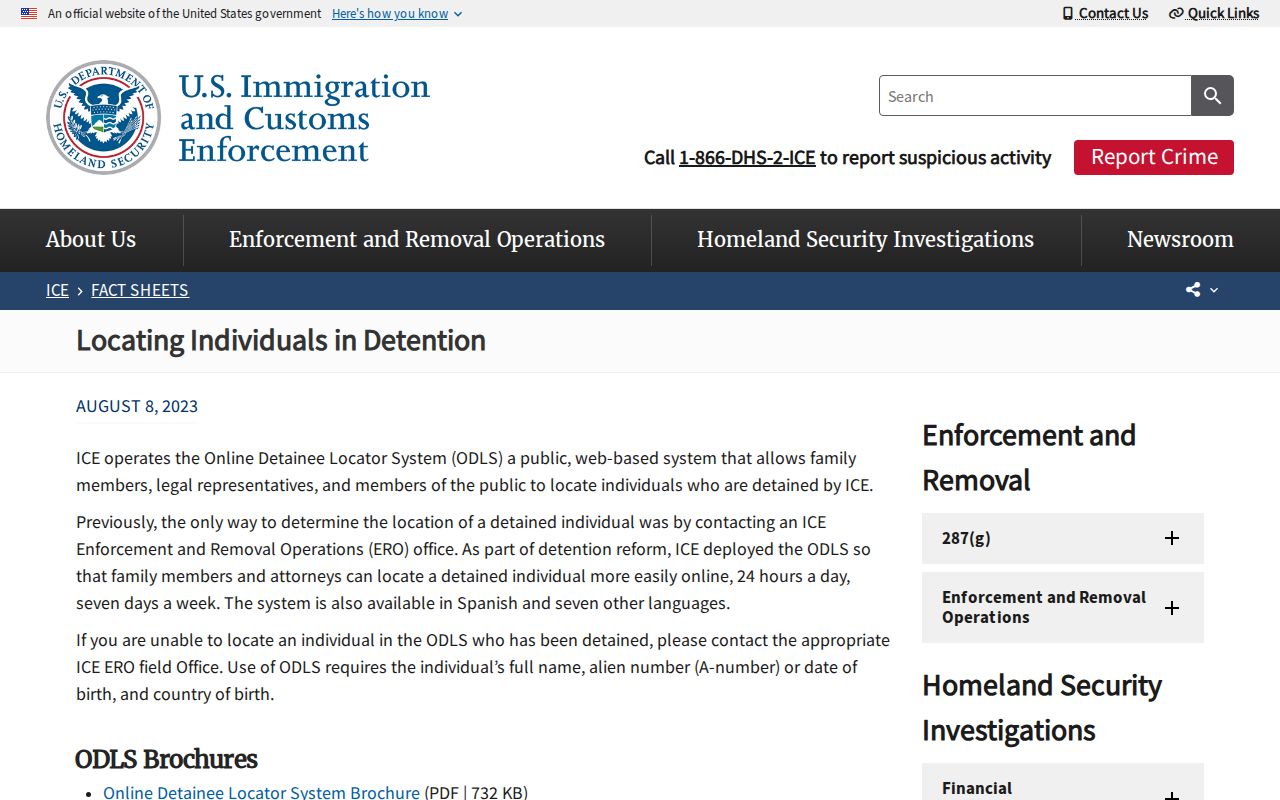
The official explanation confirms that ODLS is a present-location tool with defined coverage rather than a Cobb release database.
ICE Results Are Not Release Records
An ODLS result can help locate a person currently detained, but it does not replace the release record from the agency that transferred the person. If someone disappears from the Cobb in-custody search and then appears in ODLS, the combined evidence supports a custody transfer. It does not support the claim that the person was released into the community.
If a person once appeared in ODLS and later does not, several explanations remain possible. ICE custody may have ended, the person may have moved to a status not shown, identifying data may have changed, or another agency may hold the person. Obtain the immigration case information or responsible agency record rather than inventing a release date from the missing result.
- A-number
- An immigration file number used to identify a person in federal immigration records.
- Detainer
- A request or notice tied to another agency’s custody and possible transfer.
- CBP custody
- Custody of Customs and Border Protection, covered by ODLS only after the stated time threshold.
- Transfer
- A move between custodians, not a release to the community.
Note: ICE location information and a Cobb jail release date answer different parts of the same custody timeline.
ICE Locator Records and Contact
ODLS is a federal online system, not an ICE jail located in Cobb County. The Facility Map uses it as a custody locator because it can become relevant after a county transfer. No Cobb street address or county phone should be assigned to it. The correct entry is the federal locator and its official explanation.
Nationwide immigration custody search
Coverage: current ICE custody and CBP custody over 48 hours
Official ICE Detainee Locator
If the question is when and why Cobb custody ended, contact the Cobb Detention Facility at (770) 499-4200, Records & Identification at (770) 499-4231, or Open Record Requests at (770) 499-4728. Ask for the release date, release reason, hold information, and receiving authority when those fields are disclosable.
The county record and ODLS result should be read in sequence. The first can document departure from Cobb custody. The second can locate current federal immigration custody. Neither agency can be assumed to maintain the other agency’s complete file.
Cobb 287(g) Ended in 2021
Cobb County’s 287(g) history is important because older records and news may use language that sounds current. Local reporting states that Sheriff Craig Owens ended Cobb participation in ICE’s 287(g) program in January 2021. That historical program should not be presented as the present method for finding someone who left the Cobb jail.
A current search needs current evidence. Read the Cobb release record for a transfer or receiving agency, then use ODLS when immigration custody is indicated. Old 287(g) references may explain an earlier case, but they do not prove that a person is now detained by ICE or that every modern Cobb release is screened through the old arrangement.
The local report on the end of Cobb 287(g) participation supplies the historical date and context. The source is background, not a locator.
Community release and ICE transfer must be named separately. A person can leave the physical Cobb jail while remaining in government custody. Only the release reason and receiving agency can resolve that distinction.
Cobb Jail Names Before ICE Transfer
Local custody records can refer to the Cobb County Jail, Adult Detention Center, Jail Complex, or a tower. The Sheriff’s history says Building A was completed in 1987, Building B in 1997, and C Tower in 2010. The combined complex has a stated capacity of 3,077 beds. Those names all describe Cobb’s local detention operation, not an ICE detention facility.
The Cobb Adult Detention Center source documents the towers and the Sheriff’s recordkeeping role. That local detail helps when a transfer record names a building or the complex rather than using one standard label. The record still needs a separate receiving-agency field before ICE custody can be inferred.
This division of records is useful. Cobb documents booking, local custody, and the event that ended that custody. ICE documents covered immigration detention after transfer. Keeping the names and dates in order prevents a tower departure from being mislabeled as final immigration release.
Separate ICE From Other Custody
Several agencies can follow a Cobb jail stay. GDC handles Georgia state prison sentences. BOP handles federal prison custody after a federal sentence. USMS handles federal criminal custody placement and transportation during another stage. ICE and CBP handle immigration custody. The same person may move between systems, but no single locator shows the whole chain.
| Possible next system | Use when | Do not assume |
|---|---|---|
| ICE ODLS | Immigration custody or covered CBP custody is indicated. | That it stores old releases. |
| BOP locator | A federal prison sentence and BOP custody are involved. | That BOP and ICE are the same. |
| GDC search | A Georgia state-prison transfer occurred. | That it covers federal custody. |
| Cobb release record | The date and reason local jail custody ended are needed. | That transfer means community release. |
A federal criminal hold is not automatically an immigration detainer. Ask which authority placed the hold and which agency received the person. The resulting agency name determines the next search.
Confirm Cobb to ICE Transfers
Final confirmation requires at least two matching points: the Cobb custody event and the current ICE result. Record the date the Cobb jail says custody ended, the release or transfer reason, and the named receiving authority. Then match the ODLS person by the strongest available identifiers. A common name without an A-number or birth-country match is not enough.
If ODLS does not return a match, check data entry and the 48-hour CBP coverage rule. Next review the local release record and other custody systems. Do not convert the absence into a release claim. If immigration custody ended, the responsible federal record or case information is needed to establish when and how.
A person released from ICE may still have an immigration case or reporting duties, just as a person released from a jail may still have a criminal case. Custody status and case status are different facts. The locator answers only its covered custody question.
Note: Older Cobb 287(g) material may explain history, but current verification relies on the Cobb record and present ICE sources.