
Cobb Scheduled Versus Actual Release
A projected or scheduled date is a planning marker. It is not proof that someone has walked out of custody. For a Cobb County jail detainee awaiting trial, release can occur after a bond is posted, a pretrial order is entered, charges are resolved, or a hold is cleared. None of those events supplies a reliable fixed date far in advance. A sentenced person may have an end date in the court order, but jail credit, another agency’s hold, or a transfer order can affect where that person goes next.
State-prison records use different terms. The Georgia Department of Corrections calls the court-sentence endpoint the Maximum Release Date, or MRD. The State Board of Pardons and Paroles uses Tentative Parole Month, or TPM, for the month of final parole review. A later Board decision may set a parole release date. Actual release means the custody change occurred, whether the person entered the community, went to supervision, or transferred to another agency.
Find Cobb County Projected Dates
Begin with the facility that holds the person. The Cobb Sheriff search is for people in county custody and reports charges and bond amounts. GDC serves people in the state prison system. The parole board handles parole decisions, while Cobb courts hold the sentence and bond orders that explain local custody. Mixing those sources can turn a transfer date into a false community-release date.
- Check the official Cobb inmate search if the person is or was held at the Adult Detention Center. A missing name can mean release or transfer, not one outcome by itself.
- Read the Cobb court order for bond, sentence length, jail credit, probation, or a transfer to GDC. State Court covers misdemeanor matters; Superior Court is the key court for felony sentences.
- For a state prisoner, open the GDC offender search. Search by name, ID, case number, age, or identifying details, then note the status, location, case, and date fields shown.
- If parole information applies, use the Board’s Inmate TPM Lookup. It accepts a six-digit inmate number, GDC ID, or personal information.
- Compare the online result with the sentencing court and the correct records office. GDC directs written verification to Inmate Records and Information, PO Box 1529, Forsyth, GA 31029.
The broader Cobb County released inmate search and records path explains how to request a county release record when the jail roster no longer shows the person.
Cobb Release Date Fields
Georgia’s labels should be read separately. The MRD comes from sentence computation. TPM belongs to parole review. A final parole date is a later authorization. A person can have all three during the same state sentence, and they need not match.
| Field | What it means | What it does not prove |
|---|---|---|
| Maximum Release Date (MRD) | The longest prison time under the court-ordered sentence, unless sentence service is interrupted. | That the person will remain in prison until that day if parole or a court reduction occurs. |
| Tentative Parole Month (TPM) | The month when the Board expects to complete final parole review and may set a release date. | A grant of parole or a guaranteed release month. |
| Final parole release date | A Board-authorized date after final review and required conditions. | That no hold, misconduct issue, or later Board change exists. |
| Actual release date | The date custody changed in the jail, GDC, VINE, or release record. | Release to the community rather than transfer, unless the release reason confirms it. |
The GDC terminology page is a useful source for the exact abbreviations. The dates still need to be tied to the correct person and sentence.
The Board’s TPM explanation gives the clearest view of the tentative decision stage.
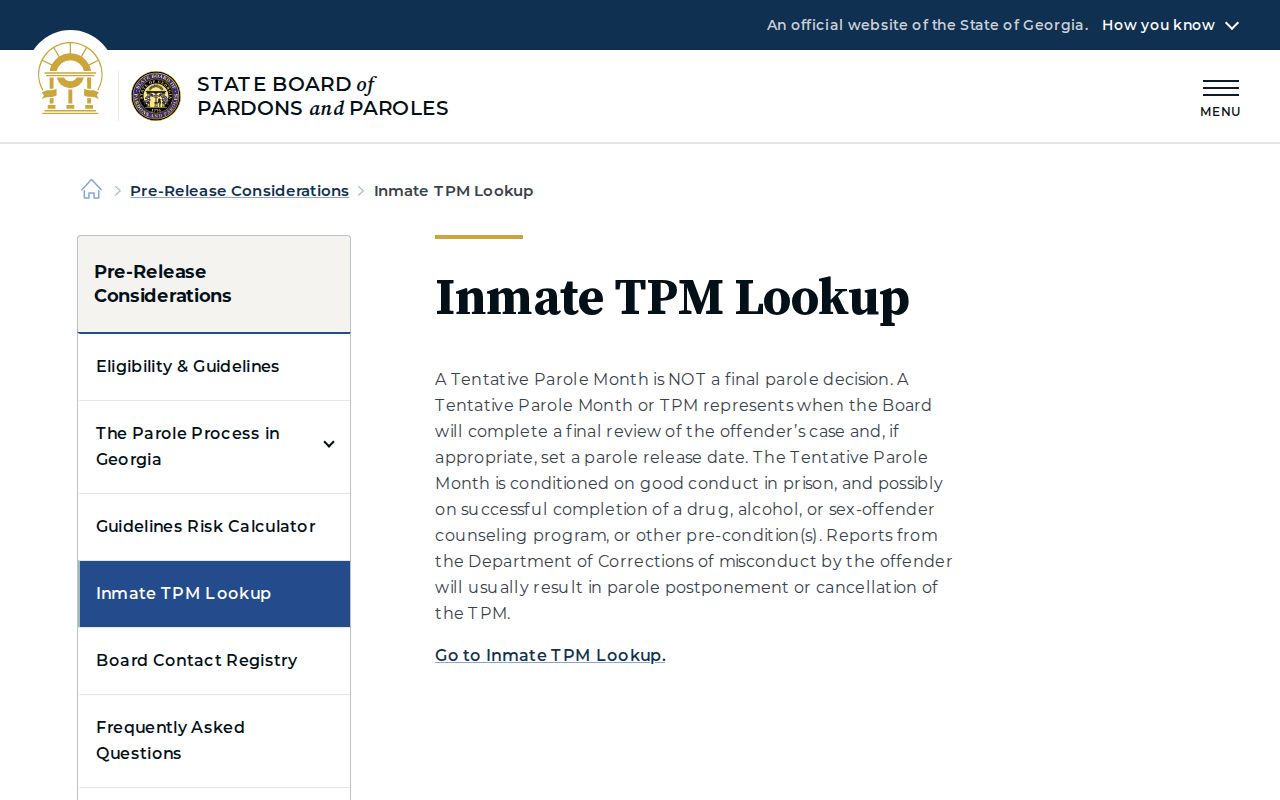
The official Board page makes clear that conduct and required programs can still affect final review after a month is posted.
When recording search results, note the date on which each source was checked. A court order may be stable while an online custody field changes. Also record the GDC ID or booking number used to match the person. That small step helps prevent a same-name result from being mistaken for the Cobb County case under review.
Georgia Release Is Not 85 Percent
Georgia projected release is not calculated through one generic 85-percent rule. The sentence, offense, parole eligibility, earned credit, and court action all matter. GDC defines MRD as the longest time under the sentence. The parole board treats TPM as a review month. Those are separate tracks, and a Cobb County state case can move along both tracks at once.
The strongest restriction is offense specific. O.C.G.A. 17-10-6.1 lists serious violent felonies and imposes mandatory service rules. Covered non-life sentences for offenses committed on or after January 1, 1995 are not parole eligible under the Board’s explanation. Some covered life cases require thirty years before parole eligibility. The statute also limits earned time, early release, work release, and other reductions, with a narrow final-year transition provision where allowed.
The statute’s restrictions are shown on the Georgia serious-violent-felony code page.
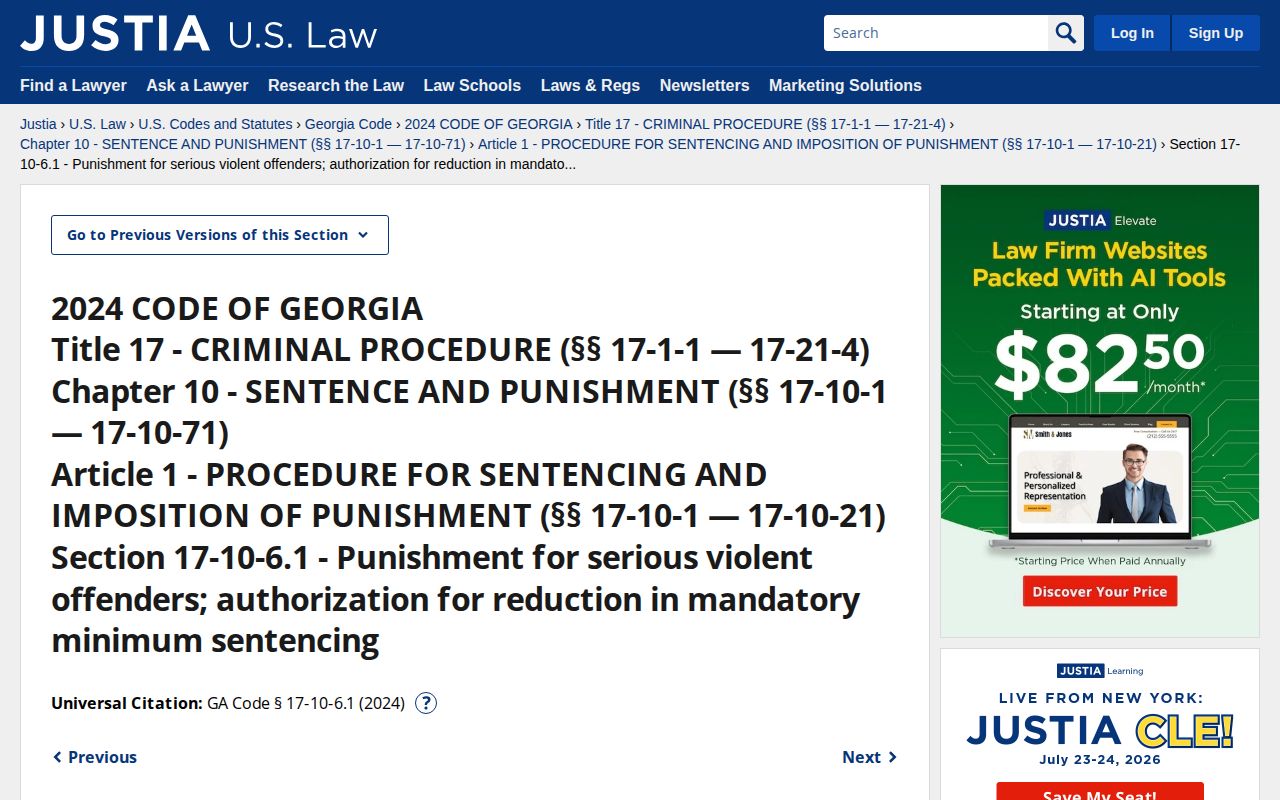
The source image reinforces why the offense and sentence must be checked before estimating any Cobb County release date.
Cobb State Release PIC Credits
Performance Incentive Credit, or PIC, is a GDC program for eligible state prisoners. It is not a Cobb County jail good-time formula. GDC says qualifying people can earn up to twelve points through case-plan completion, education or vocational improvement, work assignments, and good behavior. Those points may reduce a TPM or MRD by one to twelve months.
Eligibility has firm limits. GDC excludes death-sentence cases, sentences of two years or less, life sentences, and offenses that are not parole eligible or carry mandatory minimum terms. A displayed credit opportunity is not a promise that a date has changed. The current GDC record and sentence computation remain the sources to verify.
The GDC PIC program page shows the state’s credit rules and exclusions.
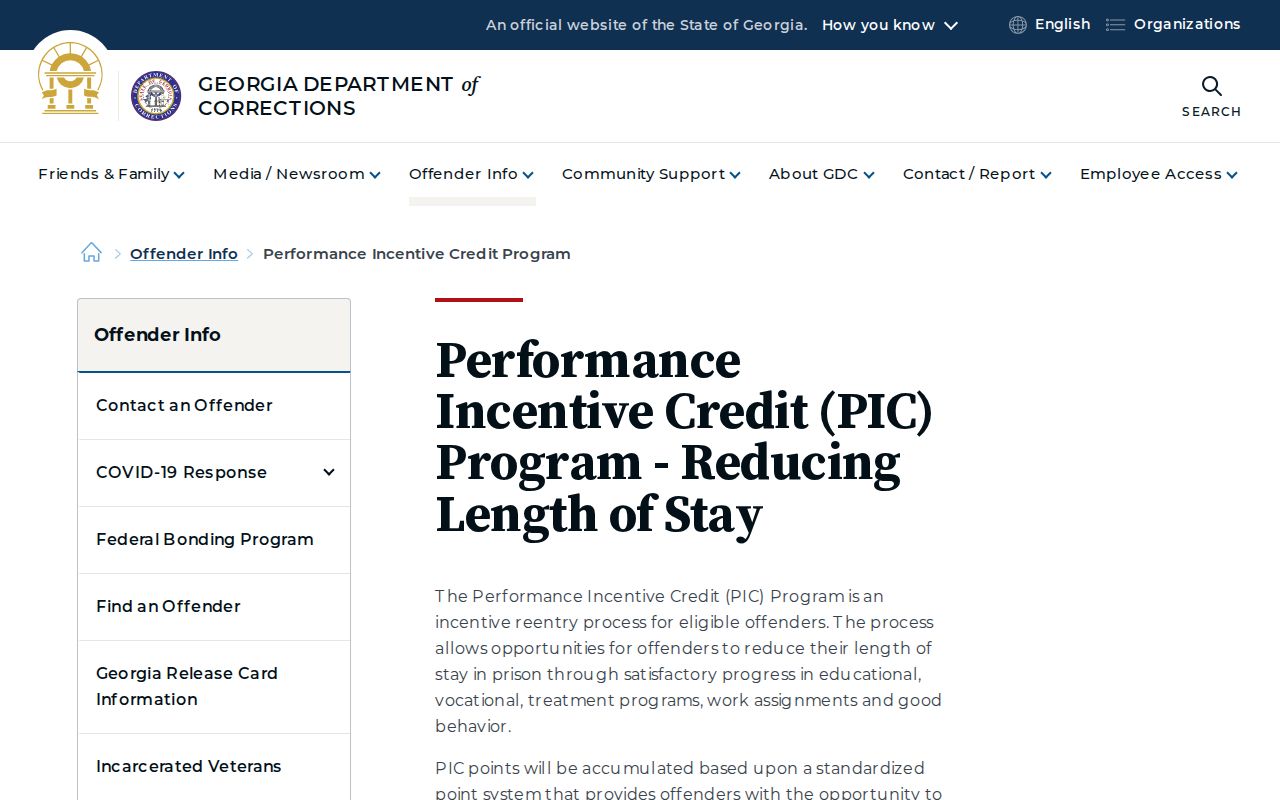
This GDC view connects program progress to the possible change in TPM or MRD without turning the credit into a guaranteed release.
Note: PIC applies to eligible GDC sentences, while Cobb jail dates must be confirmed from the local sentence and custody record.
Cobb Jail Release Computation
No official Cobb Sheriff source reviewed publishes a local good-time formula or public release-date calculator. For a county sentence, start with the judge’s order. Then account for jail credit, bond or pretrial status, court changes, holds, warrant status, and transfer instructions. A person held before trial has no computed sentence end until the court enters a sentence, and bond can lead to release before any trial or sentence.
A Cobb jail release can also be a transfer. If a felony sentence sends the person to GDC, the date the person leaves the Adult Detention Center is not the final state-prison release date. GDC then computes MRD, and the parole board controls any TPM or parole release decision. A federal or immigration hold can likewise change the receiving agency without releasing the person to the community.
Bond adds another local distinction. Cash, property, professional, driver’s-license collateral, out-of-county property, and pretrial release are among the routes published by the Cobb Sheriff. Posting an authorized bond can end physical jail custody while leaving the criminal case open. If there are several charges, the Sheriff warns that more than one bond may be required. The docket and bond record are therefore essential when an estimated jail date suddenly becomes an actual bond release.
Time served is different again. A sentencing order may credit the confinement already served and allow release when processing is complete. A dismissal or lifted hold may also end custody without any sentence countdown. These outcomes show why a county release cannot be calculated by taking a state-prison credit rule and applying it to the Cobb jail.
- Detainer
- A request or hold from another agency that may prevent community release.
- Jail credit
- Time the sentencing court credits toward a term of confinement.
- Discharge
- The end of the sentence or custody term, distinct from a transfer.
- Parole
- Conditional release from prison before the sentence’s maximum endpoint.
Why Cobb Release Dates Change
Expected dates should be checked again near release. The Board may reconsider a parole decision before release. Misconduct can postpone or cancel a TPM, while PIC can move a date earlier for an eligible state prisoner. Court action and sentence interruption affect different parts of the calculation.
| Change | Possible effect | Best confirmation |
|---|---|---|
| Misconduct report | TPM may be postponed or canceled. | TPM lookup and Board record |
| PIC award | Eligible TPM or MRD may move earlier. | GDC sentence record |
| Court-ordered reduction | Custody time may be shortened. | Signed court order and GDC record |
| Sentence interruption | MRD may change. | GDC Inmate Records |
| Hold or transfer | Person may leave one facility but remain confined elsewhere. | Release reason and receiving agency |
| Parole reconsideration | A prior date or decision may change before release. | State Board record |
Confirm Cobb County Actual Release
Use a custody-change source for the final check. Cobb participates in VINE for people in the Adult Detention Center, so an advance registration can provide notice when custody changes. The Cobb County VINELink check explains how to follow one person. A VINE notice does not explain the legal reason for release, so compare it with the jail record and court docket.
For a state prisoner, read the current GDC status and any parole record, then use written verification when the result is important. For a county detainee, call the Detention Facility at (770) 499-4200 or Records & Identification at (770) 499-4231 and request the booking and release facts available for disclosure. Ask whether the event was community release, bond, sentence completion, or transfer.
Court timing can explain a short mismatch. Cobb State Court says current-day case-management updates appear the next day, but that is a court schedule rather than a jail-roster promise. If a bond or sentence entry is new, keep checking the official docket while asking the jail for the custody event. The signed order takes priority over an estimated date copied from an older search result.
Note: A person leaving the Cobb roster may still be in GDC, federal, immigration, or another county’s custody.