
Cobb County Parole Versus Probation
Parole and probation can both place a released person under rules in the community, but they begin under different legal authority. The Georgia State Board of Pardons and Paroles decides whether an eligible state prisoner receives parole. The Georgia Department of Community Supervision, known as DCS, performs field supervision for parolees and felony probationers. Cobb State Court’s Sentence Enforcement Unit, or SEU, handles misdemeanor probation imposed by that court.
| Issue | Parole | Probation |
|---|---|---|
| How it begins | The Board authorizes conditional release before the state sentence reaches its maximum end. | A judge orders a person to serve all or part of a sentence in the community. |
| Decision record | Board parole process, TPM information, and parolee database. | Sentencing order, court docket, and supervision record. |
| Cobb field office | DCS Marietta for Cobb and Cobb Circuit. | DCS Marietta for felony cases; Cobb State Court SEU for its misdemeanor cases. |
| End point | Discharge from parole or sentence expiration. | Completion or court-ordered discharge from probation. |
- Parole
- Conditional release from state prison under a Board decision.
- Probation
- A court sentence served in the community while required conditions are met.
- Split sentence
- A sentence combining confinement with a later probation term.
- Discharge
- The formal end of the sentence or supervision term.
- Absconder
- A supervised person alleged to have stopped reporting or left supervision without approval.
Verify Cobb County Post-Release Supervision
Use the record tied to the sentence. A Cobb jail release after a misdemeanor sentence should not be searched as state parole. Likewise, a person released from GDC on parole is not confirmed through the Cobb jail roster. Court type, custody system, and the release reason determine the correct channel.
- Check the release source. Determine whether the person left Cobb jail, a GDC facility, or another system, and whether the event was release or transfer.
- For parole, search the State Board’s parolee database. Match the person with identifiers and read the status rather than assuming from a name alone.
- For a person still in state prison, use the TPM lookup explanation. TPM is a tentative review month, not current community supervision.
- For felony probation or parole in Cobb, use DCS Marietta as the local field office. Public records are the starting point; staff may not disclose protected case details.
- For a Cobb State Court misdemeanor, read the sentencing order and contact the SEU. The order states the probation term and reporting instructions.
- If a warrant or violation is suspected, compare the supervision source with the court docket and Cobb warrant contact. Absence from the jail roster is not a warrant check.
A full release date and reason may require the Cobb County release record, especially when the public roster no longer shows the person.
Cobb Parole Board Record Path
The State Board decides parole. Eligible Georgia prisoners are considered automatically, and most parole-eligible prisoners reach statutory eligibility after serving one-third of the sentence. Eligibility is not a right to release. The Board can set a future TPM, deny parole, set a final release date after review, or reconsider a prior decision before release. Serious violent felony sentences and other excluded cases follow stricter rules.
The Georgia parole process lays out the decision path.
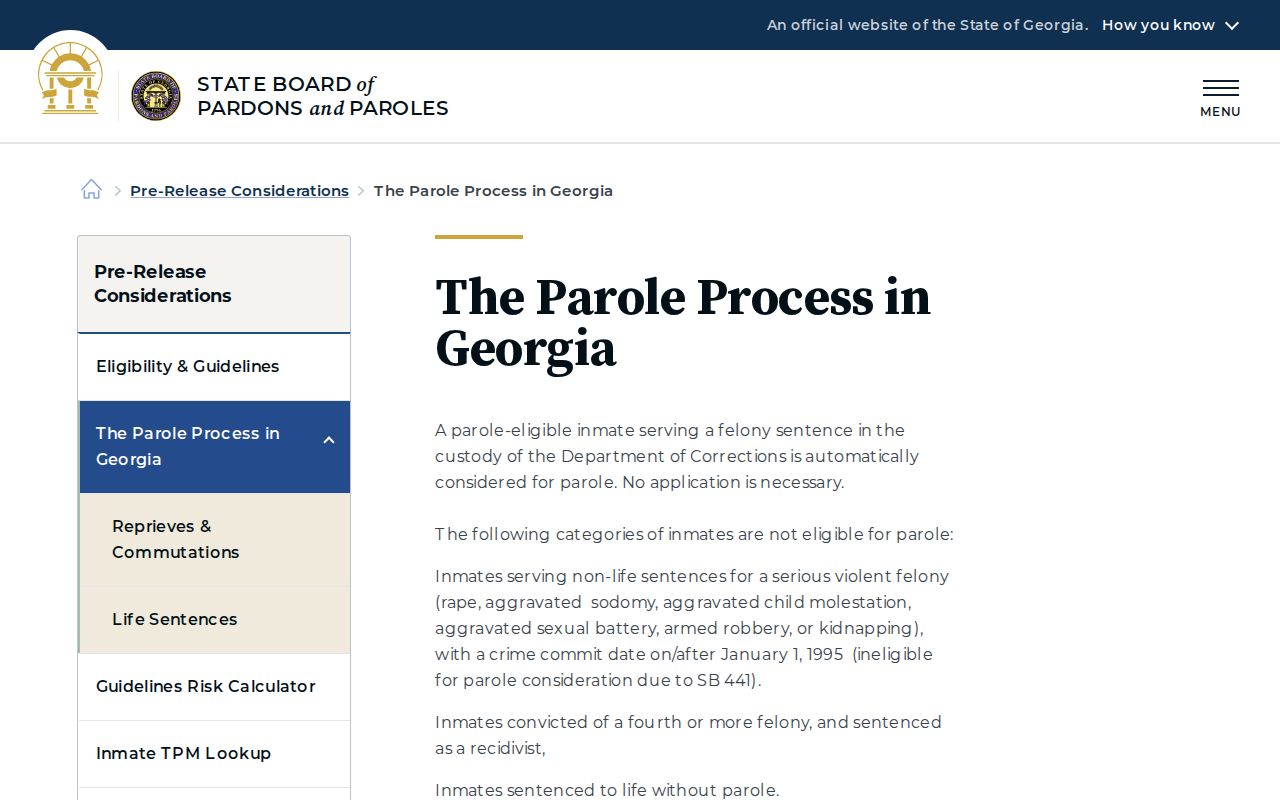
The Board’s process view helps distinguish an inmate being considered for parole from a Cobb County resident already reporting under DCS supervision.
For public lookup, the parolee database concerns people on parole, while the TPM tool concerns a tentative decision stage for a state prisoner. A final release date and actual release are still separate events. This distinction prevents a future TPM from being misread as proof that the person is already in Cobb County.
Georgia Parole Meetings and Cases
Georgia’s monthly public board meetings are policy and operations meetings. They are not public hearings where individual offender cases are called. A Board notice describes a regular first-Tuesday cadence beginning at 10:00 a.m., while current notices provide the actual date, time, and location. Because schedules can change, consult the latest Board notice before attending.
The Board’s meeting explanation states that offender cases are not discussed at those meetings.
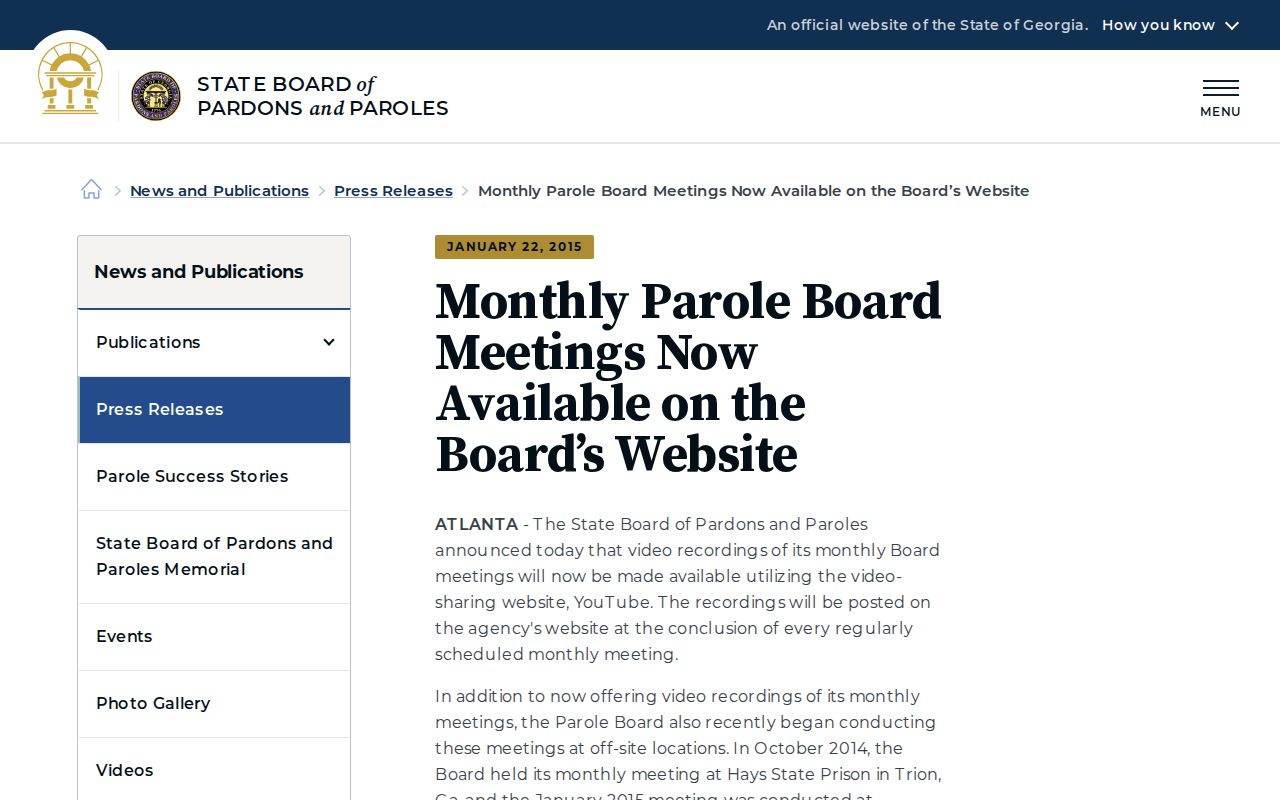
This public-meeting source directs an individual case inquiry back to the TPM lookup, parolee record, and Board process rather than a public hearing calendar.
Case outcomes may include denial, a future TPM, a final parole date after review, reconsideration, or a later discharge from parole. A majority vote governs clemency decisions. None of these outcomes should be inferred from a general meeting agenda.
Two Cobb Supervision Offices
Cobb County has two distinct local supervision paths. DCS Marietta serves Cobb and Cobb Circuit for state parole and felony probation. The Cobb State Court SEU handles misdemeanor probation from Cobb State Court. A released person may need one office or the other based on the sentence, not simply the facility from which the person walked out.
590 Commerce Park Drive, Suite 102
Marietta, GA 30060
Phone: (770) 528-4923
Monday-Friday, 8:00 a.m.-4:30 p.m.
The official DCS Marietta office listing confirms the Cobb and Cobb Circuit service area.
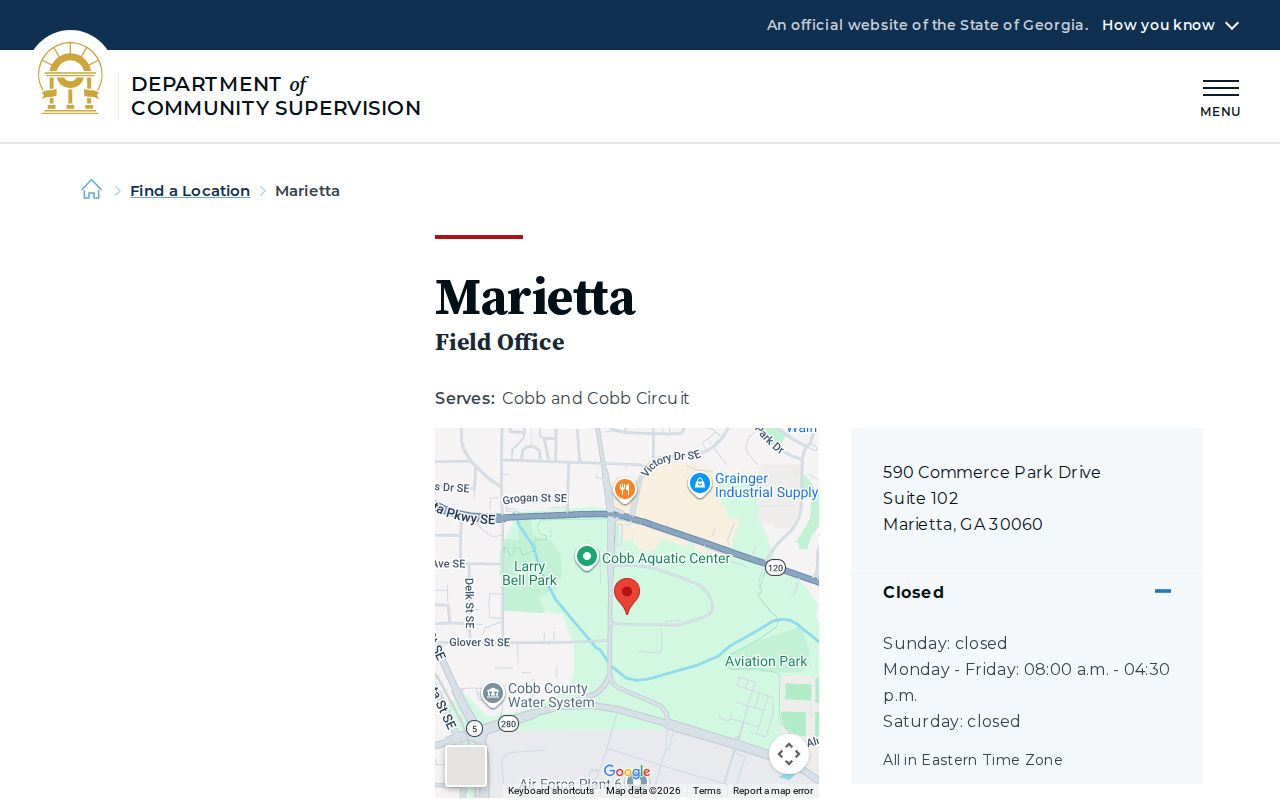
The office page provides the field location for felony supervision, while the court sentence remains the source for the legal terms.
12 East Park Square, 3rd floor
Marietta, GA 30090
Intake: (770) 427-2952
General SEU: (770) 528-1795
Note: DCS and SEU serve different sentence classes, and neither should be treated as the Cobb jail’s release-record office.
Cobb Misdemeanor Reporting After Release
Cobb State Court provides a precise local rule for a defendant on misdemeanor probation. After release from custody, the person must report in person to the SEU Intake Office within three business days or within the time stated in the sentencing order. The order controls if it gives a different instruction. Leaving jail therefore does not end the case or the reporting duty.
The Cobb misdemeanor probation page sets out that post-release reporting requirement.
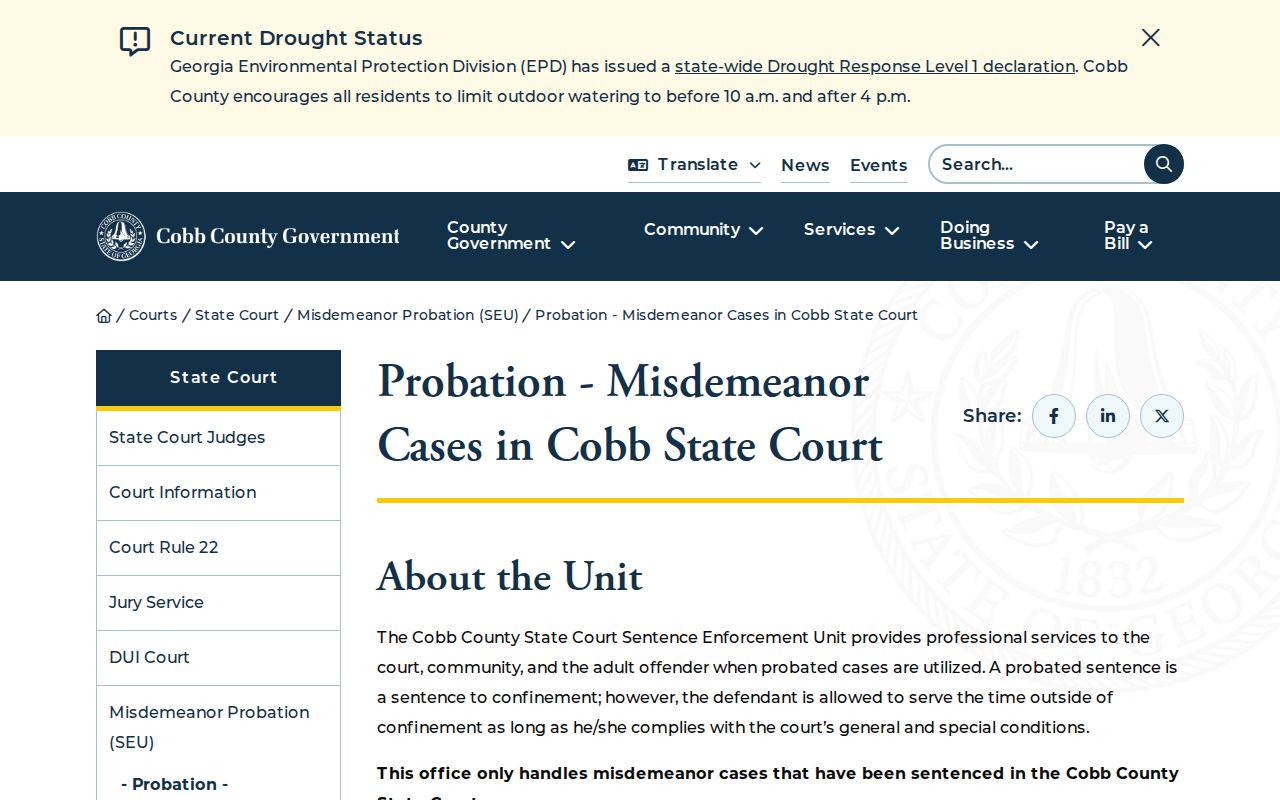
The local source separates SEU intake from DCS supervision and shows why the sentencing order must be read before choosing an office.
A probated sentence is a sentence of confinement served outside custody so long as the person complies with its conditions. That is different from parole, which follows a Board decision during a state prison sentence. It is also different from bond, which releases a person while a criminal case remains pending.
Cobb Supervision Conditions and Violations
Conditions come from the Board, court order, and supervision plan. They can include reporting, approved residence, payment duties ordered by the court, travel limits, testing, treatment, or other case-specific terms. The exact order controls. General web information cannot establish what one person must do.
A violation allegation can lead to review, a warrant, added conditions, revocation proceedings, or return to custody. An absconder is generally a person alleged to have stopped reporting or left supervision without approval. Cobb does not publish a local absconder list in the Sheriff sources reviewed. Use the parolee database, DCS or SEU, the court docket, and official warrant contacts rather than treating silence in one system as proof.
Cobb Sheriff lists Warrant Information at (770) 499-4634 and Fugitive at (770) 499-4652. Those are Sheriff channels. DCS handles alleged felony supervision violations, and the Board has a role in parole matters. SEU handles the misdemeanor cases under its authority. Calling the correct office matters because each agency owns a different piece of the record.
Confirm Cobb Supervision Discharge
Supervision ends through a formal record, not simply because a name disappears from a database. Parole may end at discharge or sentence expiration. Probation may end when the court-ordered term is completed or when a court enters an early termination or other discharge order. Outstanding violations, tolling, or a new order can affect the endpoint.
For parole, compare the parolee record with the Board and DCS record. For felony probation, use the sentencing court and DCS. For a Cobb State Court misdemeanor, use the court docket, signed order, and SEU record. Ask for the discharge date and status rather than relying on an estimated sentence end.
The court record can also show whether confinement was followed by probation as part of a split sentence. A GDC “released” status answers state custody, but it does not by itself show that every probation or parole duty ended. Keep the release record, sentencing order, and discharge document together when confirming the full timeline.
If the public parolee search and court docket seem to conflict, compare their update dates and identifiers. Then contact the agency that owns the disputed field. The Board owns the parole decision, DCS owns felony field supervision, and SEU owns its Cobb misdemeanor probation record. This division keeps a jail custody change from being mistaken for a supervision discharge. Save the final order or agency response with the matching case number and date.
Note: Release from Cobb custody and discharge from Cobb County supervision are separate events recorded by different agencies.