
Work Deployment Center Releases
The Work Deployment Center is part of the Cobb County Sheriff's Office Detention Division. Cobb says it houses non-violent, under-sentence detainees, work-release participants, and people assigned to supervised county work crews. These are local sentenced detainees, not people serving a sentence in a Georgia state prison. Their final departure is therefore a Cobb jail release unless another court order, hold, or transfer sends the person to another authority.
A completed local sentence can lead to the community, but the sentencing order may impose probation or other reporting duties. A new warrant or hold can prevent the expected release. A transfer to another county, GDC, a medical facility, federal custody, or immigration custody is also possible when the record supports it. In each case, the Cobb detention record should state why local custody ended and, when disclosable, where the person went.
Daily work release is different. Cobb describes participants as sentenced detainees who remain in a minimum-security facility while leaving for an approved outside schedule during the day. Their movement is authorized custody activity. It does not mean the sentence is complete, and seeing a participant away from the facility does not prove final release.
Confirm Work Deployment Release
Cobb does not identify a separate public roster or release feed for the Work Deployment Center. The Sheriff places the unit inside the same detention division as the Adult Detention Center and Annex. Confirmation therefore starts with the official Cobb custody search, then moves to the Sheriff's Cobb VINE channel, court records, the Detention Facility line, Work Deployment Center contact, and Records & Identification when the live search cannot answer the release question.
Use this order for a named participant:
- Check the Sheriff's official custody-search entry for a current Cobb detention result.
- Do not treat an approved work schedule or visible daytime movement as proof that custody ended.
- Review the sentencing court record for the sentence, confinement term, probation terms, or later order.
- Call the Work Deployment Center or Detention Facility for the correct records path when status is unclear.
- Ask Records & Identification for the final release record, including its date, time, reason, and any transfer notation.
If the public custody result disappears, that alone is not enough. A name mismatch, data delay, outage, transfer, or another record limit may explain the absence. Cobb's published inmate-search language focuses on individuals in custody and their charges and bond amounts, not on a rolling archive of people who completed work release. A release record or court order supplies the missing end point.
The Cobb County release search explains how to move from a current-custody check to VINE, court, GDC, federal, immigration, and open-records channels when facts point beyond the Work Deployment Center.
Work Deployment Records and Contact
The Sheriff publishes a dedicated Work Deployment Center phone number but does not provide a separate facility street address in the cited research. The contact card therefore avoids assigning the Adult Detention Center's address to this distinct unit. For the formal release document, Records & Identification is the stronger record channel because Cobb says that unit maintains arrest and incarceration records for detainees held in county detention facilities.
Cobb County Work Deployment Center
Work Deployment Center: (770) 499-4340
Operating agency: Cobb County Sheriff's Office
Sheriff Detention Records
Detention Facility: (770) 499-4200
Records & ID: (770) 499-4231
Open Record Requests: (770) 499-4728
Give the full legal name, aliases, sentence or booking date range, SOID or jail number if known, and court case number. Ask for the booking and final release record tied to Work Deployment Center custody. Useful fields include the final release date and time, release reason, sentence-completion notation, court order, holds, and any receiving agency. If the person was only away on an approved schedule, the record should not be framed as a final release.
Georgia open-records law generally requires available records within three business days or a description of the records and expected production time. Search and retrieval charges follow state limits, and the first quarter hour is not charged. The agency may apply lawful exemptions and other rules to particular fields.
About Work Deployment Center Custody
The official Work Deployment Center description says the unit uses an eligibility review. Participation also requires an approved outside schedule. Work crews are deployed throughout Cobb County to county departments, while work-release participants leave for approved daytime activity. Those details show why a simple inside-or-outside test is unreliable for this facility.
| Status | Meaning for release research |
|---|---|
| County work crew | The sentenced detainee remains under supervised Cobb custody while assigned to county work. |
| Approved work release | The participant leaves for an approved schedule but remains a sentenced detainee. |
| Final local release | The confinement term ends, subject to court orders, holds, and any supervision terms. |
| Transfer | Another agency takes custody, so the receiving system becomes the next lookup. |
The source page provides the most direct view of the unit's purpose and eligibility framework.
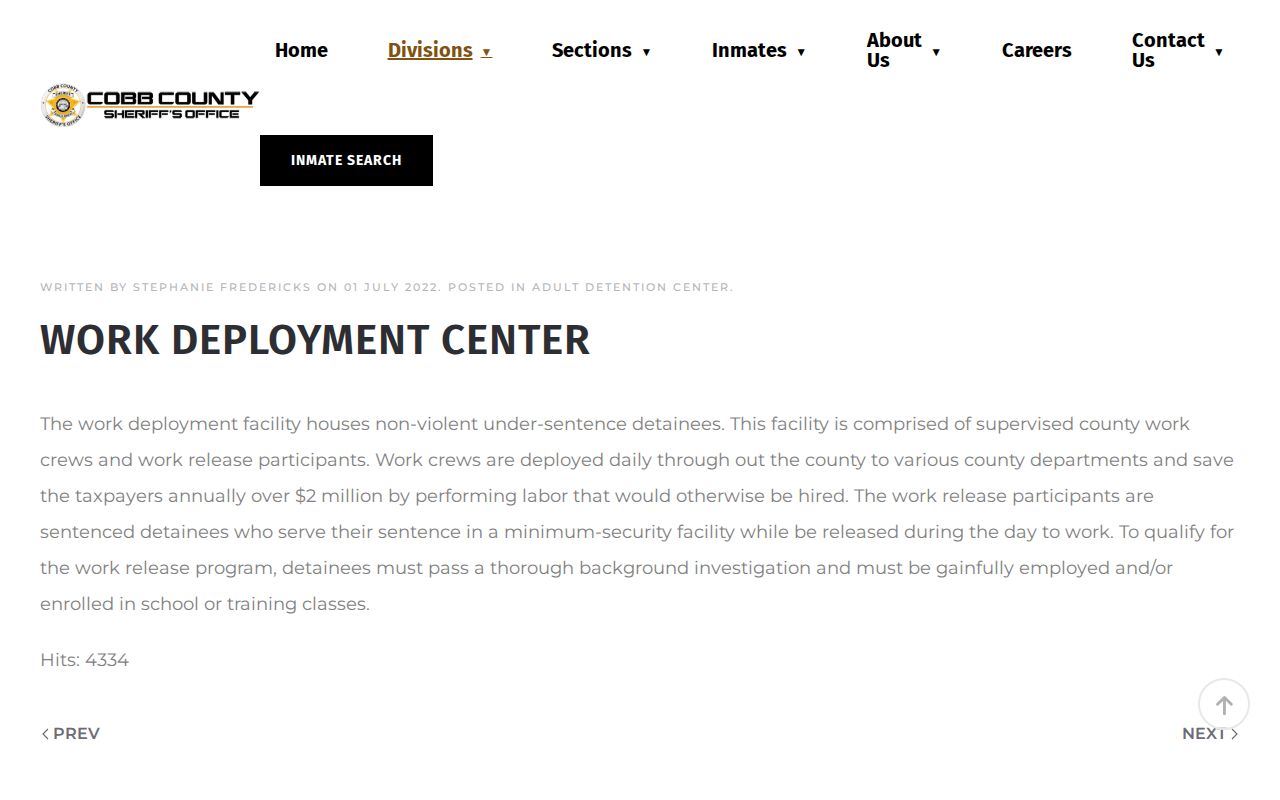
The captured official page supports the key distinction between approved work activity and final release from Cobb County detention.
Note: The official Work Deployment source supports program status, while the individual release record confirms when Sheriff custody actually ended.
Work Deployment Release and Sentencing
The sentencing order is crucial because Work Deployment Center participants are under sentence. It can show the confinement term, credit, split sentence, probation, and court instructions. The Cobb State Court record search covers traffic and misdemeanor cases within its published date range, while the official clerk record controls. Cobb's Sheriff sources do not publish a stand-alone local good-time calculator or a public final-release-date formula for this unit. Do not import GDC state-prison credit rules into a Cobb county sentence.
Release from confinement may begin a supervision phase. For a misdemeanor case sentenced in Cobb State Court, the Sentence Enforcement Unit states that the released person must report in person to intake within three business days or as directed by the sentencing order. Felony probation or parole is handled through the Georgia Department of Community Supervision, including its Marietta Field Office when Cobb is the reporting circuit. Agency type follows the sentence, not the name of the detention unit.
A court docket can explain why a release occurred, while the Sheriff record confirms that physical Cobb custody ended. Neither should be replaced by an assumption based on a work schedule. If the docket shows a later hold or revocation, check the current custody system again. If it shows probation, use the named supervision office for reporting instructions within what can lawfully be disclosed.
Note: Final release from Work Deployment custody can begin probation, so the sentencing order remains important after the jail term ends.
Work Deployment and Cobb Jail History
Cobb's broader jail history helps place the Work Deployment Center without merging it into a jail tower. The Sheriff says Building A of the Jail Complex was completed in 1987, Building B in 1997, and C Tower in 2010. Those dates describe the main Adult Detention Center complex. The Work Deployment Facility is separately named as a component of the Detention Division and has its own work-focused role.
Records may still use several related labels: Work Deployment Center, Work Deployment Facility, work release, Detention Division, or Cobb County Sheriff's Office. The varied terms do not create several release systems. They lead back to the same Sheriff records chain for Cobb detention, while the sentence and program documents supply the facility-specific detail.
This distinction prevents two errors. A tower reference should not be assigned to Work Deployment without support, and daytime release should not be called sentence completion. Ask Records & Identification to connect the person, booking, facility or program component, and final disposition when the naming on older documents is unclear.
Work Deployment Release or ICE Transfer
Final Work Deployment Center release normally follows the Cobb Sheriff detention workflow, but a transfer notation changes the next search. An immigration detainer or transfer does not mean the person returned to the community. When the Cobb record points to immigration custody, ICE's Online Detainee Locator System may show a person currently in ICE custody or in CBP custody for more than 48 hours.
Cobb's older 287(g) history should not be treated as a current lookup. Local reporting says Sheriff Craig Owens ended Cobb participation in that program in January 2021. Older files and news may still mention 287(g), yet current verification should rely on the release record and the current receiving-agency locator. A program label from the past does not establish present custody.
Use the Cobb record first to identify whether the event was release or transfer. Then use ICE ODLS only when the facts support an immigration destination. A missing ICE result can reflect scope, timing, or identifying-data issues, so it does not override a Cobb transfer notation. The same principle applies to GDC, federal, medical, and other-county transfers.