
DCS Marietta Post-Release Role
The Georgia Department of Community Supervision Marietta Field Office serves Cobb County and the Cobb Judicial Circuit. DCS supervises people on state parole and felony probation in the community. It does not book detainees, calculate a Cobb jail release, or operate a public inmate roster. A person can reach DCS supervision through several paths, including parole from GDC, direct release from local custody to felony probation, or prison release with an active probation sentence.
Georgia separates the decision from field supervision. The State Board of Pardons and Paroles decides whether parole is granted and provides public TPM and parolee lookups. GDC holds state prisoners and maintains state custody information. A sentencing court imposes probation. DCS then handles day-to-day felony supervision after release. Each agency record should be used for its own part of the process.
Verify Cobb DCS Supervision
A focused verification starts with the source that created the supervision term. DCS may answer process questions, but public staff contacts should not be treated as a promise that private case details will be disclosed.
- Decide whether the person left Cobb jail, a GDC prison, or court directly. That determines which release record to obtain first.
- For parole, use the State Board of Pardons and Paroles’ parolee database and compare the result with GDC custody information.
- For felony probation, review the sentencing order from the court of conviction. A probated or split sentence should be read as written.
- Confirm that Cobb County or Cobb Circuit is the relevant place of residence, conviction, transfer, or reporting.
- Contact the DCS Marietta Field Office for local reporting and office-process questions within disclosure limits.
- If public sources conflict, obtain the official court, parole, or corrections record rather than relying on roster absence.
The public Cobb County released-inmate search path helps identify the last custody system before this supervision stage. It is especially useful when a local jail disappearance could mean transfer to GDC rather than release to the community.
Note: A Tentative Parole Month is a review month, not proof that parole began or that DCS supervision is active.
DCS Marietta Contact Details
The field office publishes a local address, phone number, service area, and weekday hours. These details support reporting and process contact after the correct supervision type has been identified.
Georgia Department of Community Supervision
Marietta Field Office
590 Commerce Park Drive, Suite 102
Marietta, GA 30060
Phone: (770) 528-4923
Monday-Friday, 8:00 a.m.-4:30 p.m.
Serves: Cobb and Cobb Circuit
DCS also publishes a state headquarters phone, (678) 783-4337, and address at 2 MLK Jr Dr SE, Suite 866 E, Atlanta, GA 30334. The local office is the better starting point for Cobb reporting logistics. The sentencing court or parole board remains the better source for the legal authority behind supervision.
The successful manifest capture shows the official DCS Marietta location source.
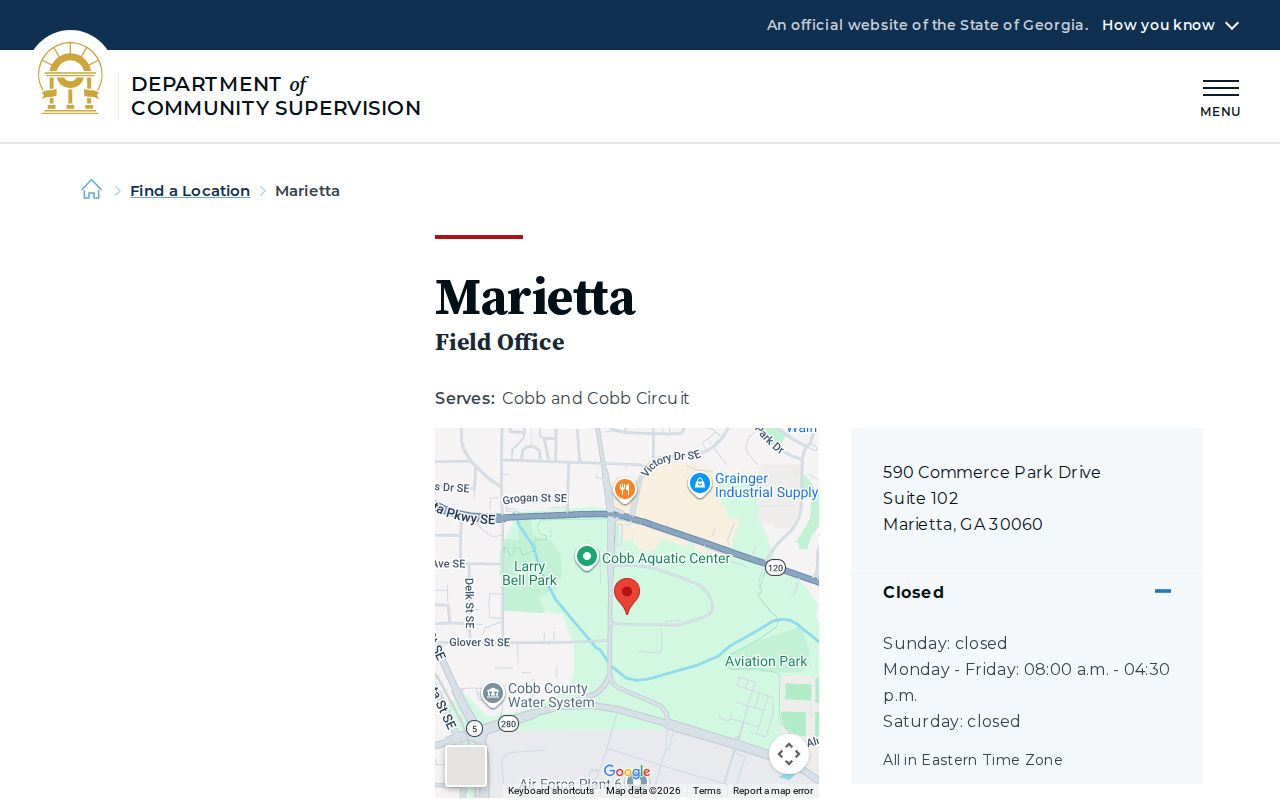
The location page confirms the Cobb service area and published contact details without turning DCS into a custody locator.
Cobb Felony Supervision Paths
Parole and felony probation can both lead to the Marietta office, but the legal source differs. Matching the term to its source prevents mistaken claims about why a person is reporting.
| Path | Authority | Public starting record | DCS role |
|---|---|---|---|
| Parole from GDC | State Board of Pardons and Paroles | Parolee database, GDC status, parole decision | Community field supervision |
| Felony probation | Sentencing court | Felony sentencing order | Community field supervision |
| Split sentence | Sentencing court | Order showing custody and probation portions | Supervision of the community term |
| Prison max-out with active probation | Prior court order | GDC release record and probation order | Reporting and transfer instructions |
Cobb State Court misdemeanor probation follows a different local route through the Sentence Enforcement Unit. DCS should not be described as the default office for every person released on probation. The offense level, sentencing court, and written order decide whether DCS or the local misdemeanor unit applies.
- Parole
- Conditional release from a state-prison sentence by the parole board.
- Felony probation
- A felony sentence served in the community under court-imposed conditions.
- Split sentence
- A sentence with both custody and probation portions.
- Discharge
- The formal end of a custody or supervision term, not merely release from a facility.
Cobb DCS Record Limits
The DCS office is a practical local contact, but it is not a public case-file counter for every supervision detail. Public confirmation should begin with the parolee database, the sentencing order, the GDC record, or the appropriate clerk. Phone staff may explain reporting procedures without confirming private facts about a named person.
For a parole question, the parole board decides the release and maintains the parole decision channel. For a felony probation question, the court order establishes the term. For a prison release date, GDC is the corrections source. DCS handles field supervision once that authority is in place. A current Cobb jail roster does not answer any of those post-release questions.
If an official record is needed, send the request to the agency that maintains it. Georgia’s Open Records Act generally requires production of available public records within three business days or a response describing the records and expected timetable. Exceptions and privacy limits still apply. A narrow request tied to the correct agency is more useful than asking DCS for jail, court, and parole documents it did not create.
Note: Absence from a public parolee search does not establish that felony probation, another supervision type, or a restricted matter does not exist.
Cobb Parole Decision Trail
Parole has several dates that should not be collapsed into one. The parole board says most eligible Georgia prisoners become eligible after serving one-third of the sentence, but eligibility does not guarantee release. The Board may set a Tentative Parole Month, deny parole, or change a prior decision before release. TPM is the month of final review, not the final release date.
For a person convicted in Cobb and held by GDC, begin with the GDC identity and custody record. Then use the parole board’s TPM lookup or parolee database as appropriate. A parolee result can support post-release status, while the DCS Marietta office supplies the local Cobb field-supervision layer. The actual release date should still be reconciled with the GDC or parole release record.
Felony probation has a different trail. The sentencing court creates the probation term, and the written order determines its structure. Someone may leave GDC after max-out yet still have active probation. Another person may leave Cobb jail directly to a felony probated sentence. DCS can supervise either community term, but the court and corrections records explain why.
Alleged violations also belong to their proper source. DCS handles field supervision, while a court, parole authority, or warrant record shows formal action. Cobb research found no local public absconder list. Confirm a warrant through official channels instead of inferring it from a missing roster or search result.
Cobb Release and ICE History
Older Cobb records or news may refer to the Sheriff’s former participation in ICE’s 287(g) program. Local reporting states that Sheriff Craig Owens ended Cobb participation in January 2021. That history does not create a current DCS lookup, and it does not show that someone reporting to DCS is in immigration custody.
When a Cobb jail release actually involved transfer to immigration authorities, the jail release or transfer record is the first source. ICE’s Online Detainee Locator is used for a person currently in ICE custody or in qualifying CBP custody. DCS Marietta remains a parole and felony probation field office. These channels may concern the same individual at different times, but no direct operational link should be inferred without an official record.
Release to the community, transfer to ICE, and reporting to DCS describe three different events. Keep them separate in any Cobb County release timeline.
Cobb Release and Jail History
Cobb’s Adult Detention Center history explains why local records may use several jail names. Building A was completed in 1987, Building B in 1997, and C Tower in 2010. The Sheriff lists a combined bed capacity of 3,077. References to the Cobb County Jail, Adult Detention Center, Jail Complex, or a tower generally point to the county detention operation, not to DCS Marietta.
This distinction matters after release. The Sheriff’s Office maintains the county incarceration and release record. GDC maintains state-prison custody information. The parole board decides parole. DCS supervises qualifying people in the community. A person may move through more than one system, but the Marietta Field Office did not operate the jail, create the local booking, or determine the jail’s release time.
Use the jail name and booking identifiers when requesting the custody record. Use DCS Marietta only after the record or supervision authority points to Cobb felony supervision.