
Correct Cobb Registry Records
A concern about an official record should go to the agency that owns that record. The Cobb Sheriff and GBI manage their parts of registry access. A Cobb court clerk maintains the court file. Sheriff Records & Identification maintains county arrest and incarceration material, while GDC maintains state-prison records. One office cannot automatically correct every source.
Georgia’s criminal-history restriction process is separate from registry access. GBI explains that O.C.G.A. 35-3-37 permits restriction of certain criminal-history records when approved by the prosecutor. For arrests after July 1, 2013, the person contacts the prosecutor; for earlier arrests, the process begins at the arresting agency. Restriction should not be promised, and a missing public record should not be assumed to result from restriction.
Open-records requests can obtain public material from the correct custodian, subject to legal exceptions. Georgia generally requires available public records within three business days or an agency response identifying the records and a production timetable. A request for a Cobb release record should include the name, booking identifier if known, date range, and exact release fields sought. A registry question should identify the registry record instead.
Photos have another legal boundary. Georgia restricts agency posting and disclosure of booking photos under O.C.G.A. 35-1-19, while the State Sexual Offender Registry is a specified legal use. A photo in a qualifying registry record does not make the whole jail photo archive public online. Keep the registry image, booking photograph, and corrections photo in their distinct official contexts.
Cobb Registry Record Scope
The Cobb County Sheriff’s sex-offender page states that the office maintains a current registry of people living, working, or attending school in Cobb County who are required to register. The Sheriff also submits that information to the Georgia Bureau of Investigation for online viewing by county. This creates local and state access to the same limited subject area.
Registration applies only when Georgia law requires it. A person released after a non-registrable case will not belong in this channel. Conversely, a registry entry can remain relevant after release because it concerns current registration duties rather than a past jail roster. The legal framework is O.C.G.A. 42-1-12, and the GBI is the central state registry location.
Check Cobb Registry Status
A registry check should remain tied to the qualifying purpose of identifying a required registrant and the county connection shown by official sources.
- Open the Cobb Sheriff registry information page and confirm the local access route.
- Use the GBI statewide registry for online county viewing.
- Match the person carefully using the identifying information provided by the official record.
- Read whether the Cobb connection concerns living, working, or attending school in the county.
- Do not infer the jail release date or release reason from registry presence.
- For release proof, obtain the Sheriff, GDC, or court record from the system that held or sentenced the person.
A missing registry result has a narrow meaning. It may mean the person is not shown as a qualifying Cobb registrant in the source checked. It cannot establish that the person was never arrested, never incarcerated, or has not been released. The Cobb County release search uses the separate jail, court, GDC, VINE, federal, and records-request paths for those questions.
Note: Registry access applies to registrable offenses only and should never be expanded into a general released-inmate search.
Cobb Registry Access Channels
Cobb provides both a local Sheriff route and statewide GBI access. Public inspection is also available at Sheriff’s headquarters. Each channel concerns registry status, not a full incarceration file.
| Channel | What it provides | What it does not provide |
|---|---|---|
| Cobb Sheriff sex-offender page | Local registry information and access direction | A general jail release archive |
| GBI online registry | State registry data viewable by county | All arrests or all released people |
| Public inspection at Sheriff headquarters | Local official inspection route | A substitute for a certified release record |
| Sheriff Records & Identification | County incarceration and release records when disclosable | State-prison discharge authority |
| GDC and court records | State custody or case disposition | Automatic proof of current registry compliance |
The local registry source was captured successfully for the image manifest.
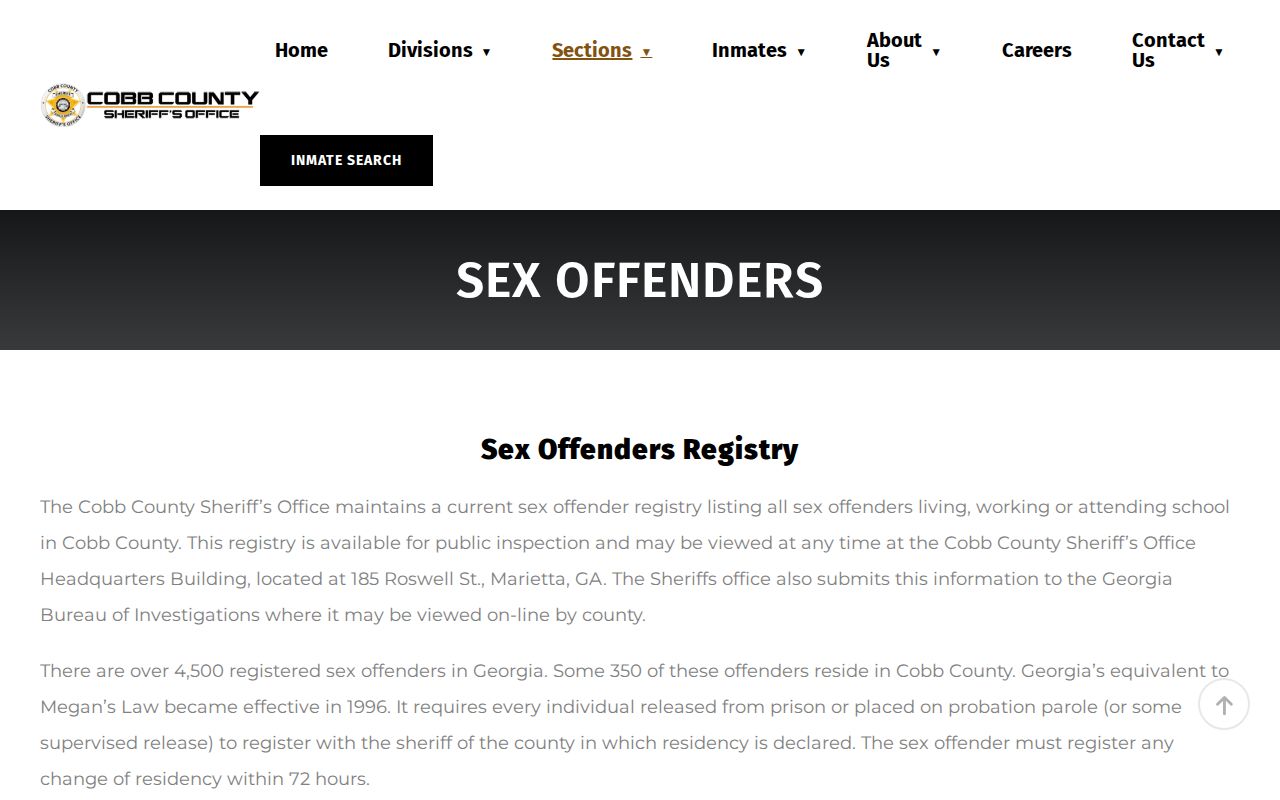
The Sheriff page supports local inspection and submission of qualifying Cobb registry information to GBI.
Cobb Registry Law and Photos
O.C.G.A. 42-1-12 governs Georgia’s sexual offender registry and places GBI at the center of the statewide data system. Cobb’s Sheriff page describes the county-facing part of that system. The law should not be reduced to a claim that every person convicted of any offense appears. Registration depends on the statutory category and official records.
Georgia’s booking-photo rules also distinguish the registry from a general mugshot gallery. O.C.G.A. 35-1-19 generally limits agency posting of booking photographs while recognizing specified legal uses, including the State Sexual Offender Registry. A registry image therefore appears in a specific statutory context. It does not establish that Cobb publishes booking photos for all current or released detainees.
- Registry
- An official status system for people with a legal duty to register.
- Booking record
- The jail record created when a person enters custody.
- Release record
- The record showing when and why a custody system ended its hold.
- Record restriction
- A Georgia process that can limit access to certain criminal-history records when approved through the proper authority.
A registry entry, booking record, and release record can concern the same person, but they remain different records with different custodians and purposes.
Cobb Release Versus Registration
Registry status is best read after the custody question has already been answered. A Sheriff release record can state when Cobb jail custody ended. A GDC record can address state-prison status. The court record explains the sentence and disposition. The registry then shows a qualifying person’s current registration connection to Cobb.
| Question | Best source |
|---|---|
| Is the person currently in Cobb jail? | Sheriff inmate search or detention contact |
| When and why did Cobb jail custody end? | Sheriff booking and release record |
| Was the person released from state prison? | GDC, parole, and discharge records |
| What was the case outcome? | Correct Cobb court and official disposition |
| Is a qualifying person registered in Cobb? | Cobb Sheriff and GBI registry |
The registry does not supply a universal release date. Living, working, or attending school in Cobb may establish why the county is associated with the entry, but it does not show that the person was released from the county jail. A registrant may have served time in another county or in GDC.
For a correction or official clarification, contact the agency responsible for the disputed record. Avoid asking the registry to resolve a court disposition or asking the court clerk to certify current registry status.
Cobb ICE History Is Separate
Cobb’s former participation in ICE’s 287(g) program sometimes appears in older news and detention discussions. Local reporting states that Sheriff Craig Owens ended county participation in January 2021. That history does not create a registry category, and registry presence does not indicate immigration custody.
If a Cobb jail release involved an immigration transfer, the Sheriff release or transfer record should say so, and current ICE custody is checked through ICE’s own locator. The sex-offender registry answers whether a qualifying person is registered in connection with Cobb. There is no direct operational link between the two sources unless an official case record establishes one.
Keeping these systems apart also prevents a transfer from being mislabeled as release to the community. ICE custody, county registration, and jail release are distinct facts.
Note: Older 287(g) references describe historical Cobb detention practice, not a current registry search method or present release presumption.
Cobb Jail History Is Separate
The Sheriff’s jail page dates Building A to 1987, Building B to 1997, and C Tower to 2010, with 3,077 beds across the complex. That history explains why records may use Cobb County Jail, Adult Detention Center, Jail Complex, or tower names for the detention operation.
The registry is not another part of that physical complex. A person may disappear from the live jail search after release and later appear in the registry only if a registration duty applies. That later appearance does not preserve the old jail roster or prove the release date. The Sheriff’s Records & Identification Unit remains the source for county incarceration and release records.
Use the jail name, booking number, and date range in a release-record request. Use the Cobb and GBI registry channels only for qualifying registration status. The two sources may be compared, but neither should be made to perform the other’s role.