
Understanding Cobb County Releases
A release means that one agency's physical custody has ended. It does not always mean the person is free of all custody or court duties. The Cobb County Sheriff's Office holds pretrial and some sentenced detainees at its detention complex. A person can leave that custody by bond, pretrial release, time served, sentence completion, court order, or transfer. The record must identify which event occurred.
Custody type controls the next search. A local jail release belongs in Sheriff detention and court records. A transfer to the Georgia Department of Corrections is not a community release, so GDC becomes the next source. A state prison discharge may end at the maximum release date or begin parole. Federal Bureau of Prisons and ICE records cover their own systems only. This distinction prevents a live county roster from being used to answer a state or federal release question.
- Discharge
- The formal end of custody or supervision in the system that issued the record.
- Time served
- Release after the custodial part of a sentence has been satisfied.
- Detainer
- A request or hold that may send a person to another authority instead of the community.
- Parole
- Conditional community release from a prison sentence under state supervision.
Cobb County Release Types
The release reason changes what should be checked next. Cobb's bonding rules also make clear that leaving jail on bond does not resolve the criminal case. The person remains responsible for court appearances until the matter is adjudicated. A transfer is even more distinct: it ends Cobb jail custody while another agency's custody may begin.
| Release type | Meaning | Next record |
|---|---|---|
| Bond or pretrial release | Physical jail custody ends while the case continues. | Bond paperwork and the originating Cobb court docket |
| Time served or sentence complete | The local custodial term has been met. | Sentencing order, Sheriff release record, and any supervision instructions |
| Court order or case resolution | A judge or case event authorizes release. | Official court record and jail release entry |
| Transfer | The person leaves Cobb custody for another authority. | Receiving jail, GDC, BOP, ICE, or other named agency |
| State prison parole or max-out | GDC custody ends under parole or at the sentence endpoint. | GDC, Parole Board, and DCS records |
Note: A release entry marked transfer should never be read as proof that the person entered the community.
Cobb County Bond Release Options
The Sheriff's Cobb bonding information documents an unusually broad local set of bond paths. They include cash, property, out-of-county property, professional bond, driver's-license collateral, and pretrial release. More than one bond may be required when a booking involves several charges. The published non-refundable fee is $20 for each bond instrument.
Bond release answers only the custody question. The surety assures that the principal, meaning the released person, will appear in court until adjudication. Pretrial release can also carry conditions, and a violation may lead to another arrest. To learn whether bond caused a recent disappearance from the jail search, compare the Sheriff's bond data with the case docket and request the release reason when the public view is unclear.
Cobb County Release Record Fields
Records & Identification maintains incarceration material for people housed in the Cobb detention facilities. A useful request identifies the booking and asks for the exact fields needed to show when and why custody ended. Not every field is promised in the public inmate interface, and some material may be restricted or redacted. The following inventory reflects the records described in the Cobb research, not a claim that every item appears online.
| Field | What it shows |
|---|---|
| Full name, alias, and SOID or booking number | Connects the release to the correct detention event. |
| Booking date and time | Marks when Cobb custody began for that booking. |
| Release date and time | Marks when Sheriff custody ended. |
| Release type or reason | Distinguishes bond, time served, court order, completed sentence, or transfer. |
| Charges, court, and case number | Links the jail event to the case that may explain release. |
| Bond amount and instrument | Shows the terms when release was bond based. |
| Facility component | May identify the jail, Annex, or Work Deployment component. |
A booking photograph may also be maintained, but Georgia law places special limits on posting and some disclosures. It should be requested separately and subject to the agency's required lawful-use statement.
Request Cobb County Release Records
The Sheriff's contact directory lists Records & ID at (770) 499-4231 and Open Record Requests at (770) 499-4728. Georgia's Open Records Act presumes access to public records, including photographs and computer data, unless an exemption applies. The agency must provide available records within three business days or describe the records and give a production timetable. Letter- or legal-size copies may cost no more than ten cents per page, and the first quarter hour of search, retrieval, and redaction time is not charged.
- Identify the person with a full name and any known SOID, booking number, or case number.
- State the booking date range and ask for the release date, release time, and release reason tied to that booking.
- Submit the request through the Cobb Sheriff's open-records channel or contact Records & Identification for routing.
- Ask for an electronic copy when available and request a cost estimate before work begins.
- Compare the response with the official court docket if the record says bond, court order, sentence completion, or transfer.
1825 County Services Parkway
Marietta, GA 30008
Records & ID: (770) 499-4231
Open Record Requests: (770) 499-4728
No official Sheriff source reviewed states how long a released person remains visible in the online inmate search. A durable release record should therefore be requested instead of relying on an assumed online retention window.
Georgia Law and Cobb Records
O.C.G.A. 50-18-70 establishes Georgia's strong presumption that public records should be open for inspection. O.C.G.A. 50-18-71 sets response and fee rules. Those laws support access to a Cobb release record, but they do not erase exemptions, sealing orders, record restrictions, or privacy limits.
Georgia calls its process for limiting eligible criminal history information “record restriction.” The Georgia Bureau of Investigation explains that arrests after July 1, 2013 generally begin with the prosecutor, while older arrests begin with the arresting agency. Restriction is not the same as pretending the booking never occurred. Official court and agency handling depends on the disposition and the approved restriction.
Find Released Cobb County Inmates
Begin with the agency that last had custody. A Cobb arrest points first to the Sheriff's live inmate search. A state sentence points to GDC. A federal prison term belongs in the BOP locator. A possible immigration transfer calls for ICE ODLS. The result must then be checked against a release, court, or supervision record.
- Use the Adult Detention Center page and official inmate search to see whether the person is still in Cobb custody.
- If the name is absent, check a VINE alert, the relevant Cobb court docket, and the Detention Facility line at (770) 499-4200.
- Use GDC when the Cobb record suggests a state transfer or the person served a Georgia prison sentence.
- Use the Parole Board and DCS for state parole or felony probation, and Cobb State Court SEU for misdemeanor probation.
- Use BOP or ICE only when federal or immigration custody is supported by the facts.
- Request the Sheriff release record when the online sources do not state the release reason and time.
GDC Search for Cobb Releases
The Georgia Department of Corrections offender search is the state-prison route. It supports searches by name, ID or case number, age, and identifying details. GDC says the tool is for offenders currently in a GDC facility, so it should not be treated as the Cobb jail archive. The agency also warns that public information should be verified in writing with Inmate Records and Information, PO Box 1529, Forsyth, GA 31029.
| Search or record field | Use |
|---|---|
| Name | Broad match when no state identifier is known |
| GDC ID or case number | Narrows records with a stable identifier |
| Age and descriptors | Separates people with similar names |
| Current status or location | Shows whether the person is in a state facility or has another displayed status |
| Maximum Release Date | The longest prison time under the court sentence |
| TPM reference | Points to a tentative parole review month, not a guaranteed release date |
The official GDC search screen shows how state records are separated from Cobb's jail records. Open the live GDC offender query before relying on the captured interface.
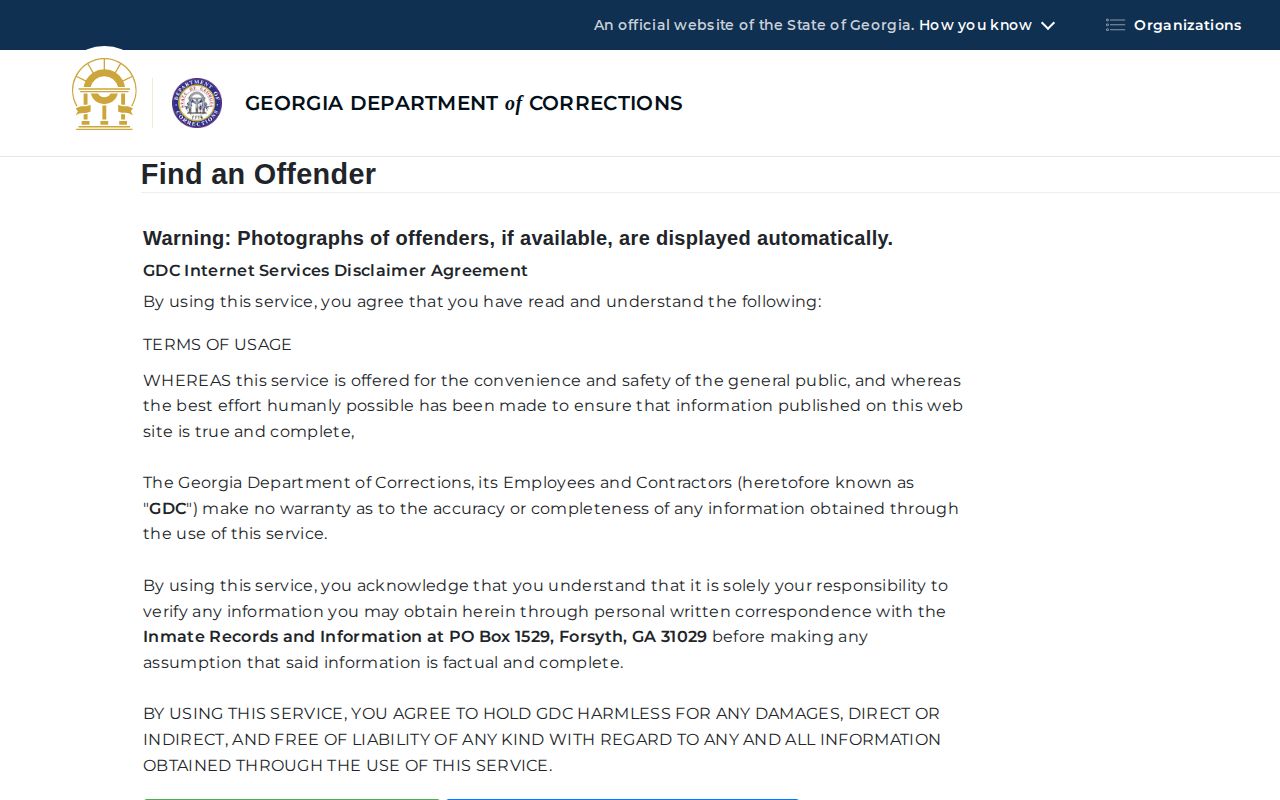
The search can establish a state-prison path, while the GDC verification warning explains why a written record remains the final check.
Cobb Release Records by Court
Cobb has separate court searches, and the case type decides which one is useful. The State Court search covers traffic and misdemeanor cases filed from April 26, 1999 through the current year. It says today's case-management changes appear the next day and warns that the official court record controls. The Magistrate Court search accepts a name, case number, or citation number and may help with warrants, first appearances, and bond activity. Felony case research belongs with the Superior Court Clerk.
A docket can explain why custody ended, but it is not the jail release log. Look for a bond order, dismissal, sentence, or transfer-related event, then compare it with the Sheriff record. A next-day court update can also trail the actual custody change.
Cobb Release Reporting Deadline
Cobb State Court supplies a local post-release rule that a roster cannot show. Its Sentence Enforcement Unit handles misdemeanor probation for cases sentenced in that court. After release from custody, the defendant must report in person to the intake office within three business days or follow the different deadline stated on the sentencing order.
This is misdemeanor supervision, not parole and not DCS felony probation. A released state prisoner or felony probationer in Cobb may instead report through the Department of Community Supervision's Marietta Field Office. Checking the sentence type avoids sending a person to the wrong office.
Cobb Releases and ICE Transfers
Older Cobb news and records may mention the federal 287(g) program. Local reporting states that Sheriff Craig Owens ended Cobb's participation in that program in January 2021. That history should not be used as proof of a present transfer practice. Current verification begins with the Cobb jail release record and, when immigration custody is actually indicated, the ICE Online Detainee Locator System.
ODLS finds people currently in ICE custody or in CBP custody for more than 48 hours. It is not a Cobb release archive. A Sheriff record that says transfer may show the end of county custody, while an ICE result may show that custody continued elsewhere.
Cobb Jail Names and Towers
“Cobb County Jail,” “Adult Detention Center,” and “Jail Complex” can all refer to the main Sheriff detention operation at 1825 County Services Parkway. The Sheriff's facility history states that Building A was completed in 1987, Building B in 1997, and C Tower in 2010. The combined complex has a stated capacity of 3,077 beds.
Those names matter when an old booking or court record lists a tower instead of the modern public label. They do not create separate release searches. Records & Identification remains the common record path, while the Work Deployment Center and Annex are separate components within the same Detention Division.
Cobb Release Alerts and Registries
Cobb has a local release-notification layer through VINE. The Sheriff's victim-notification page says the office partners with Appriss to provide automated registration and notice for people in the Adult Detention Center. A person who registers while the custody record is active can receive a notice when custody changes. If an alert states that the person was released, compare it with the Sheriff record and court docket to learn whether the reason was bond, time served, sentence completion, or transfer. VINE reports the custody event, not the full case disposition.
A missing VINE result does not settle the question. The name may be entered differently, the record may no longer be retained in the public display, or the person may have moved into a system outside Cobb's VINE coverage. Call the Detention Facility or request the release entry when a name cannot be reconciled. For a state prisoner, GDC and the Parole Board remain the correct route. Federal releases belong in BOP.
The Cobb and GBI sex-offender registries form a narrower post-release source. They apply only to people who must register under Georgia law and who live, work, or attend school in Cobb County. A registry entry can show current registration information after release, but it does not establish the date or reason that jail custody ended. Use it only when the underlying case is registrable, and use the Sheriff, GDC, or court record for the actual release.
Note: A VINE alert or registry entry should be matched to the correct person before drawing a conclusion about custody.
Where Cobb Release Status Appears
A single name can move through several systems. Use the source whose custody type matches the event, then confirm what its status actually means.
| System | Who it covers | What to verify |
|---|---|---|
| Cobb inmate search | People currently in Sheriff custody | Presence indicates current custody; absence needs follow-up |
| Sheriff release record | Past Cobb detention booking | Release date, time, reason, and destination |
| GDC and Parole Board | Georgia state prisoners and parole cases | State status, MRD, TPM, or parole decision |
| Cobb courts | Cases filed in the matching court | Bond, disposition, sentence, and later orders |
| BOP locator | Federal prisoners from 1982 onward | A past release date with no facility can show BOP custody ended |
| ICE ODLS | Current ICE custody or qualifying CBP custody | Transfer-related current immigration detention |
Cobb County Release Systems
Cobb release research extends beyond one jail building. Each linked page follows the record path for its own facility or public system.
- Cobb County Adult Detention Center: the primary local jail and Sheriff release-record source.
- Cobb County Work Deployment Center: minimum-security work crews and work-release participants whose daytime movement is not final release.
- Cobb County Detention Annex: a detention component using the same Sheriff custody and records route.
- Georgia Department of Corrections: the statewide route after a Cobb transfer or for a state-prison release.
- DCS Marietta Field Office: local parole and felony probation supervision.
- Cobb State Court Sentence Enforcement Unit: misdemeanor probation after release.
- BOP, ICE ODLS, and the Cobb sex-offender registry: specialized systems, not general county release lists.